Security

Top Cyber Threats Facing Law Enforcement Agencies

(And What CJIS-Compliant Organizations Must Do About Them)

Cyber threats targeting law enforcement agencies continue to increase in both scale and sophistication, driven by ransomware evolution, credential theft, and nation-state activity.

Recent federal cybersecurity advisories confirm that ransomware actors are actively exploiting vulnerabilities across organizations worldwide, including government systems.

For organizations responsible for CJIS compliance in Florida, these threats directly impact:

  • CJIS audit outcomes
  • Operational continuity
  • Access to critical systems like NCIC and FCIC

Why Law Enforcement Remains a High-Value Target

Law enforcement environments include:

  • Always-on systems (CAD, RMS, dispatch)
  • Sensitive criminal justice data (CJI)
  • Federally connected systems (CJIS, NCIC, fusion centers)

Attackers target these systems because disruption and data exposure have immediate operational consequences.

Recent federal enforcement actions highlight that ransomware groups continue targeting critical infrastructure and government systems, posing ongoing risks to public safety.


Top Cyber Threats Facing Law Enforcement Agencies

1. Ransomware Attacks and Extortion

Ransomware remains the most critical threat to CJIS-regulated environments.

  • Modern ransomware includes data theft + encryption (double extortion)
  • Threat actors exploit unpatched systems and weak credentials
  • Attacks target public safety and government infrastructure

Federal advisories show ransomware campaigns impacting organizations across 70+ countries using known vulnerabilities.

Real-world example:
The U.S. Department of Justice coordinated a global disruption of the BlackSuit (Royal) ransomware group, which had targeted critical infrastructure and generated millions in illicit proceeds.

CJIS Impact:

  • System encryption and downtime
  • Data exfiltration
  • Immediate compliance violations

2. Credential Theft and Identity-Based Attacks

Credential-based attacks are now a primary intrusion method.

Attackers use:

  • Phishing and spear phishing
  • Infostealer malware
  • Credential replay and MFA bypass

These techniques allow attackers to operate using valid credentials, making detection more difficult.

CJIS Impact:

  • Unauthorized CJIS access
  • Violations of access control requirements
  • Increased audit risk

3. Malware-as-a-Service and Infostealers

Cybercrime has become highly scalable.

  • Malware platforms enable repeated attacks across many victims
  • Infostealers harvest credentials silently
  • Attack infrastructure is reused across campaigns

Law enforcement operations have disrupted malware ecosystems, but reports show these networks quickly re-form after takedowns.

CJIS Impact:

  • Silent data exfiltration
  • Long dwell times before detection
  • Compromised CJIS-connected endpoints

4. Supply Chain and Vendor Risk

Third-party vendors remain a critical vulnerability.

Law enforcement depends on:

  • CAD/RMS vendors
  • Cloud platforms
  • Managed service providers

Recent enforcement actions demonstrate how ransomware groups target critical infrastructure sectors through interconnected systems.

CJIS Compliance Note:
Agencies are still responsible under the CJIS Security Addendum, even when a vendor is compromised.

CJIS Impact:

  • Vendor breach = agency liability
  • Increased audit scrutiny
  • Potential non-compliance findings

5. AI-Accelerated Cyberattacks

Attackers are increasingly leveraging automation and advanced tooling.

Federal cybersecurity efforts emphasize the need for continuous monitoring and rapid detection as threats evolve.

This shift increases:

  • Attack speed
  • Volume of phishing and malware campaigns
  • Difficulty of detection

CJIS Impact:

  • Faster compromise timelines
  • Greater reliance on real-time monitoring
  • Increased risk of undetected breaches

6. Operational Disruption and System Downtime

Cyberattacks are increasingly focused on availability and disruption.

Targets include:

  • Dispatch systems
  • Records management systems
  • Law enforcement IT infrastructure
  • Email Systems

Ransomware campaigns are specifically designed to halt operations and force rapid response decisions.

CJIS Impact:

  • Violations of availability requirements
  • Public safety consequences
  • Immediate compliance exposure

The CJIS Compliance Connection

Each of these threats directly maps to CJIS Security Policy requirements:

CJIS mandates:

  • Continuous monitoring and logging
  • Incident response capability
  • Strong authentication and access control
  • Vendor risk management

Organizations pursuing CJIS compliance in Florida must implement these controls or risk:

  • CJIS audit failures
  • Loss of CJIS system access
  • Legal and operational consequences

Why a CJIS MSSP is Critical

A CJIS MSSP (Managed Security Services Provider) helps agencies:

  • Monitor systems 24/7
  • Detect and respond to threats quickly
  • Maintain continuous CJIS compliance

This is especially critical for agencies without dedicated internal security teams.


How Rolle IT Cybersecurity Supports CJIS Compliance

Rolle IT Cybersecurity is a trusted CJIS MSSP supporting agencies and contractors across Florida. Contact Rolle IT Cybersecurity for more information [email protected] 321-872-7576

Core Services:

  • 24/7 SOC monitoring and threat detection
  • CJIS-compliant incident response planning
  • Endpoint protection (CrowdStrike-powered)
  • Vulnerability management and hardening
  • CJIS audit help and remediation

Outcomes:

  • Maintain uninterrupted CJIS access
  • Reduce risk of cyber incidents
  • Pass CJIS audits with confidence
  • Strengthen operational resilience

Final Takeaway

The most significant cyber threats facing law enforcement today include:

  • Ransomware and extortion attacks
  • Credential theft and identity compromise
  • Malware and infostealer ecosystems
  • Supply chain vulnerabilities
  • Rapidly evolving attack methods

For organizations handling CJI, cybersecurity is inseparable from compliance.

Agencies that adopt proactive, CJIS-aligned cybersecurity strategies especially with a qualified CJIS MSSP are best positioned to:

  • Protect sensitive data
  • Maintain operations
  • Achieve CJIS compliance in Florida

FAQ

What is CJIS compliance in Florida?

CJIS compliance in Florida means adhering to the FBI CJIS Security Policy as enforced by FDLE, including requirements for access control, encryption, incident response, and auditing.


What are the biggest cybersecurity threats to law enforcement?

The top threats include ransomware, credential theft, phishing, malware infections, and supply chain attacks targeting sensitive law enforcement systems.


What is a CJIS MSSP?

A CJIS MSSP is a managed security provider that delivers monitoring, detection, and incident response services aligned with CJIS requirements.


What happens if you fail a CJIS audit?

Failure can result in corrective actions, increased oversight, or loss of access to CJIS systems such as NCIC or FCIC.


How can agencies prepare for a CJIS audit?

Preparation includes implementing monitoring, incident response plans, access controls, documentation, and working with a CJIS MSSP. Contact Rolle IT Cybersecurity for more information [email protected] 321-872-7576


Why is incident response critical for CJIS compliance?

Incident response ensures agencies can detect, contain, and report breaches involving CJI, which is a core CJIS requirement.


Sources

Top Cyber Threats Facing Law Enforcement Agencies Read More »

Cybersecurity Tabletop Exercises for CJIS and Critical Infrastructure Organizations

How Law Enforcement and Critical Infrastructure Teams Prepare for Cyber Incidents

Cyberattacks targeting law enforcement agencies, public safety systems, and municipal infrastructure have become one of the fastest-growing threats facing government organizations.

Ransomware groups, cybercriminal syndicates, and nation-state actors increasingly target organizations that manage critical systems and sensitive data, including criminal justice information (CJI).

For agencies operating under the CJIS Security Policy, protecting that data is both a legal requirement and a public safety responsibility.

One of the most effective ways to prepare for cyber incidents is through cybersecurity tabletop exercises.

These structured simulations help agencies test their ability to respond to cyberattacks before a real crisis occurs.

At Rolle IT, we work with law enforcement agencies and critical infrastructure teams to conduct realistic tabletop exercises that strengthen incident response readiness and CJIS compliance.

Understanding Cybersecurity Risks for CJIS and Public Safety Systems

Public sector organizations are attractive targets for cybercriminals because their systems often support essential services.

Common targets include:

  • Law enforcement databases
  • Emergency dispatch systems
  • municipal networks
  • utility control systems
  • transportation infrastructure

When cyber incidents disrupt these systems, the consequences can extend beyond IT outages.

They may impact:

  • emergency response operations
  • officer safety
  • public safety communications
  • access to investigative databases
  • continuity of government services

Because of these risks, agencies responsible for protecting criminal justice information must ensure they are prepared to respond quickly and effectively.

What Is a Cybersecurity Tabletop Exercise?

A cybersecurity tabletop exercise is a guided discussion-based simulation that walks participants through a realistic cyber incident scenario.

Rather than testing technology, the exercise evaluates:

  • incident response procedures
  • decision-making processes
  • communication and escalation protocols
  • coordination between departments
  • regulatory reporting requirements

Participants discuss how they would respond to each stage of an evolving cyber incident.

This format allows organizations to identify weaknesses in their response plans without disrupting operations.

Why Tabletop Exercises Are Essential for CJIS-Regulated Organizations

Many agencies have incident response plans on paper but limited experience executing them under pressure.

During a real cyberattack, teams must make rapid decisions involving:

  • system containment
  • forensic evidence preservation
  • CJIS reporting requirements
  • communication with leadership and law enforcement partners
  • public communications and media inquiries

Tabletop exercises expose gaps in these processes before an actual incident occurs.

For organizations responsible for criminal justice information, this preparation is essential.

Rolle IT’s Methodology for Cybersecurity Tabletop Exercises

Rolle IT conducts structured tabletop exercises designed specifically for CJIS environments and critical infrastructure organizations.

Our approach focuses on realism, operational coordination, and regulatory alignment.

Scenario Development Based on Real Threats

Each exercise begins with the development of a customized scenario reflecting current cyber threats affecting government organizations.

Examples include:

  • ransomware spreading across a CJIS network
  • unauthorized access to law enforcement databases
  • supply chain compromise impacting emergency communications systems
  • insider misuse of sensitive criminal justice information

These scenarios are mapped to NIST incident response phases and CJIS security requirements.

Multi-Department Participation

Cyber incidents affect more than IT teams.

Effective tabletop exercises involve leadership from across the organization, including:

  • IT and cybersecurity teams
  • CJIS security officers
  • command staff or agency leadership
  • legal and compliance teams
  • public communications personnel

This approach ensures agencies practice responding to incidents as a coordinated organization.

Progressive Incident Simulation

During the exercise, facilitators introduce new developments that evolve the scenario.

Participants must respond to situations such as:

  • detection of suspicious network activity
  • system outages affecting operations
  • ransomware demands
  • potential exposure of criminal justice information
  • media or regulatory inquiries

This evolving structure helps teams practice responding to the complexity of real cyber incidents.

After-Action Analysis and Security Improvements

Following the exercise, Rolle IT conducts a detailed review of the organization’s response.

This analysis evaluates:

  • communication and coordination
  • CJIS policy adherence
  • incident escalation procedures
  • forensic readiness
  • recovery and continuity planning

Organizations receive actionable recommendations to improve their incident response capabilities and cybersecurity posture.

Aligning with National Cybersecurity Standards

Rolle IT tabletop exercises are aligned with widely recognized cybersecurity frameworks.

These include:

  • CJIS Security Policy
  • NIST SP 800-61 Incident Response Guide
  • NIST SP 800-171
  • CISA critical infrastructure guidance

This alignment ensures exercises help organizations meet both regulatory requirements and operational security goals.

The Growing Cyber Threat to Critical Infrastructure

Cybercriminal groups increasingly target organizations that support essential public services.

Recent incidents have demonstrated how ransomware and cyber espionage campaigns can disrupt:

  • emergency communications
  • municipal government operations
  • law enforcement networks
  • utility infrastructure

For agencies responsible for protecting communities, cyber preparedness has become a critical operational priority.

Building Cyber Resilience Through Realistic Exercises

Tabletop exercises are one of the most effective ways for organizations to strengthen cyber resilience.

Agencies that conduct regular exercises gain:

  • faster incident response coordination
  • clearer leadership decision processes
  • improved CJIS compliance awareness
  • stronger communication across departments
  • greater confidence during real cyber incidents

Preparing for cyber threats before they occur is essential for protecting both public safety systems and sensitive criminal justice information.

Strengthening Cybersecurity for Public Sector Organizations

At Rolle IT, we help law enforcement agencies, government organizations, and critical infrastructure teams prepare for evolving cyber threats.

Our cybersecurity services include:

  • CJIS cybersecurity compliance consulting
  • cybersecurity tabletop exercises
  • managed detection and response (MDR)
  • security operations center (SOC) monitoring
  • incident response planning

Through realistic training and advanced cybersecurity capabilities, we help organizations protect the systems that communities rely on every day.

Rolle IT facilitates Tabletop Exercises with organizations of all sizes. Contact us at [email protected] for more information.

Cybersecurity Tabletop Exercises for CJIS and Critical Infrastructure Organizations Read More »

A Strategic Microsoft Partner for GCC High Environments

For organizations already operating under Microsoft 365 GCC High (GCCH) requirements, the primary challenge is not determining whether GCCH is needed, but ensuring it is implemented, governed, and sustained correctly.

Rolle IT supports executive leadership and procurement stakeholders by providing structured oversight and long-term partnership for GCC High environments, reducing operational risk and ensuring contractual obligations are met.


Executive and Procurement Priorities

Organizations required to operate in GCC High face several non-negotiable priorities:

  • Proper eligibility validation and license issuance
  • Secure, defensible tenant configuration
  • Alignment with contractual and regulatory obligations
  • Audit readiness and documentation support
  • Long-term operational sustainability

Rolle IT works with leadership teams to ensure these priorities are addressed consistently and deliberately, without introducing unnecessary complexity or risk.


Rolle IT’s Role as Your GCC High Partner

Rolle IT acts as a governance-focused Microsoft partner, supporting GCC High environments throughout their lifecycle.

Our role includes:

  • Eligibility and Licensing Assurance
    Supporting accurate qualification, documentation, and license procurement through authorized channels.
  • Tenant Architecture and Governance Advisory
    Advising on administrative structure, identity strategy, and access models aligned with security and compliance expectations.
  • Security and Compliance Alignment
    Ensuring GCC High configurations support requirements such as NIST SP 800-171, DFARS, ITAR, and CJIS, where applicable.
  • Operational Readiness and Continuity
    Supporting adoption, change management, and long-term sustainability within the GCC High environment.

This approach enables leadership to make defensible, well-informed decisions.


Designed for Oversight and Accountability

GCC High environments must withstand scrutiny—from auditors, assessors, and contracting authorities.

Rolle IT emphasizes:

  • Clear governance models
  • Documented configuration decisions
  • Repeatable security practices
  • Reduced reliance on ad-hoc or reactive changes

This structure supports accountability and reduces long-term risk.


Engagement Beyond Initial Implementation

GCC High is not a one-time project. Licensing changes, new users, evolving contracts, and assessments introduce ongoing demands.

Rolle IT remains engaged to support:

  • Licensing lifecycle management
  • Configuration and governance reviews
  • Audit and assessment preparation
  • Strategic guidance as requirements evolve

Our clients value continuity and institutional knowledge, not one-time delivery.


A Partner for Leadership and Procurement Teams

Rolle IT complements internal IT organizations by providing specialized expertise and advisory support where it matters most. We help leadership and procurement teams move forward with confidence, clarity, and documented assurance.


Partner with Rolle IT

For organizations already committed to GCC High, selecting the right Microsoft partner is a critical governance decision.

Rolle IT provides the oversight, experience, and continuity required to operate GCC High environments with confidence and control.

[email protected] 321-872-7576

A Strategic Microsoft Partner for GCC High Environments Read More »

Top 10 Failed CMMC Controls, #10 System Baselining

CMMC Journey Guides

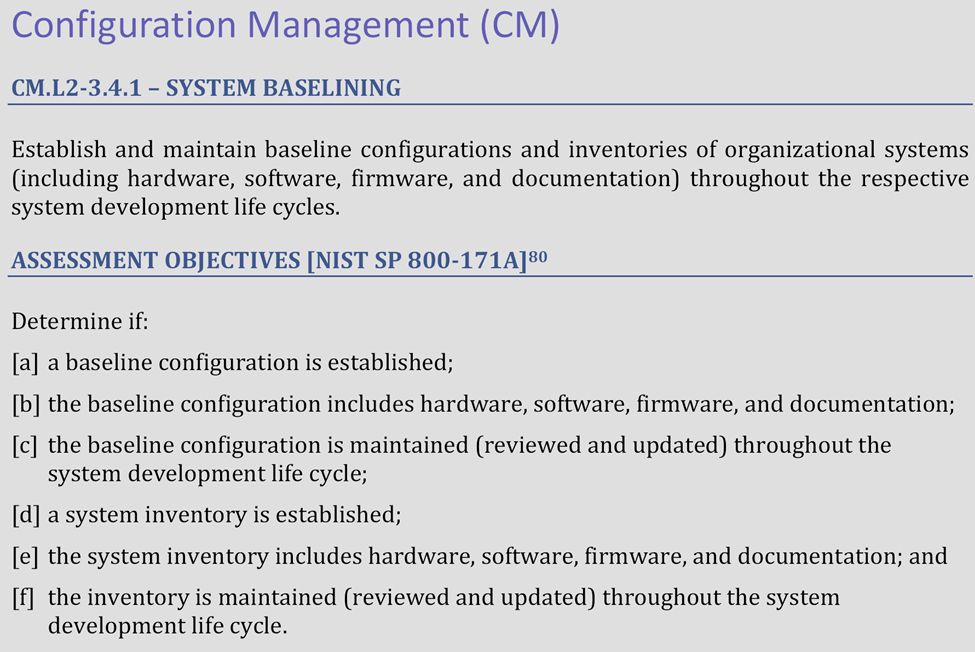
#10- CM.L2-3.4.1: System Baselining

When working with individual controls, we know that they have to be dissected from an objective level. For this specific control out of the 110 controls, 320 objectives in CMMC, I have chosen to split it up with objectives a/b/c and d/e/f. Two parts, mainly covering “baseline configurations” and “system inventory”. If you work with CUI, you don’t get to “wing it” on configurations or inventory. CM.L2-3.4.1 asks you to do two big things across the system life cycle:
(1) build and maintain secure, documented baselines for each system and
(2) keep a trustworthy inventory that actually reflects reality in production.

The CMMC Level 2 Assessment Guide spells this out clearly, including exactly what assessors will “Examine/Interview/Test” to verify it’s in place. In this article we will get granular with 1) Dissecting the Control, 2) What full implementation looks like, 3) Why this Control Fails, 4) A Quick Checklist.

1) Dissecting The Control in Two Logical Halves

Objectives A/B/C: Baseline Configurations

  • [a] Establish a baseline configuration for each system component type. For every deployed machine type, you define the approved build: OS version, required apps, hardened settings, network placement, and anything else that affects security and function.
  • [b] Include the full buildout for each system. Baselines must cover hardware, software, firmware, and documentation—not just a golden image. Think platform model/BIOS, OS and app versions/patch status, and the config parameters that lock it down.
  • [c] Maintain it consistently moving forward. As your environment changes, review and update baselines so they always reflect the live system and enterprise architecture (create new baselines when things change materially).

What lives in a solid baseline:

  • Laptops/Desktops/Servers
  • Enclaves (e.g., entire VDI and each component), laptops/workstations, servers
  • ALL Applications per asset group
  • Versions & patch levels for OS/apps/firmware
  • Networking elements: routers, switches, firewalls, WAPs, etc.

Objectives D/E/F: System Inventory

  • [d] Establish a system inventory. A real one… no, seriously. This is ideally software via Asset Management agent(s) that automate most of this process. BUT that is not required, just advice. Any devices classified as any of the CMMC asset types will be in-scope and should be in the system inventory.
  • [e] Include the full buildout for each system in the inventory. (again: hardware, software, firmware, and documentation).
  • [f] Maintain it. Review and update it as systems evolve so it stays accurate to production reality in a reasonable and timely manner.

What lives in a solid inventory:

  • Manufacturer, device type, model, serial number, physical location, owners/main users
  • Hardware specs & parameters
  • Software inventory with version control and potentially licensing information
  • Network info (machine names, IPs)

Assessor angle (what they look at): Policies, procedures, SSP, Configuration Management plan, inventory records and update logs, config docs, change/install/remove records; plus, interviews with the people who build and maintain these things; plus, tests of the actual processes and mechanisms you use to manage baselines and the inventory.

2) What Full Implementation Looks Like

A simple, effective pattern from the Assessment Guide:

  1. Design a secure workstation baseline. Research the hardened settings that deliver the least functionality needed to do the job, then test that baseline on a pilot machine.
  2. Document it (build sheet, settings, required software, version list, how it’s joined to the network) and roll it out to the rest of that asset class from the documented baseline.
  3. Update the master inventory manually, or make sure an appropriate agent is live to reflect the software changes and the devices now at the new baseline.
  4. Schedule a regular review interval to re-validate versions, patches, and settings; or make review a normal part of your SOP that is updated on a regular basis.

Scale that approach across all deployed machine types:

  • Enclaves & Virtual Desktop Infrastructure: baseline the image and each supporting component (connection brokers, secure gateways, user-profile layers, and file-system layers).
  • Laptops & Workstations: document hardware models and BIOS/UEFI versions, OS build, required apps, GPOs/MDM profiles.
  • Servers: OS baselines per role (AD/DNS, file, app, DB), service hardening, approved modules/agents.
  • Networking: switch/router/Firewall/WAP firmware baselines, approved feature sets and templates.
  • Applications Inventory: version standards, required configs, and how they’re deployed/updated.
  • Docs: build guides, change records.

And yes, tie everything to change management controls, because the second you patch, you either (1) update the baseline or (2) record an approved deviation and a plan to reconcile. The guide’s “Potential Assessment Considerations” call out version/patch levels, configuration parameters, network info, and communications with connected systems (proof for [a]/[b]), and timely baseline updates ([c]).

How computers are actually baselined, end-to-end:

  1. Procurement & intake: approve models; capture serials/asset tags at receipt; record ownership/location.
  2. Imaging: apply the gold image (or Autopilot/MDT/SCCM/Intune flow); inject drivers; enforce policies (GPO/MDM).
  3. Hardening: apply CIS/NIST-inspired settings that match your baseline; lock services/ports/protocols; set logging.
  4. Application set: install required software; check licensing; verify versions.
  5. Join & place: join to domain/MDM; put it in the right OU/MDM group/VLAN/segmented subnet.
  6. Recordkeeping: update the inventory with HW/SW/firmware/docs and network details; save the build sheet and sign-off.
  7. Review cadence: calendar-based (e.g., quarterly) and/or event-based (whenever a major patch lands) to keep baseline and inventory current ([c], [f]).

3) Why This Control Fails (Top-10, sitting at #10)

Short answer: it’s a lot of work. and it’s the kind that doesn’t scream until something goes terribly wrong…

  • Documentation feels heavy. A real baseline covers hardware, software, firmware, and documentation and needs regular updates. That is inherently more than “we have an image.” It is buildout documentation, version matrices, network placement, and the approval trail that shows the baseline evolved with your environment.
  • Inventory discipline gets neglected. Many shops run with a “good enough” list. CMMC expects manufacturer, model, serial, location, owner, license/version data, and network identifiers; and expects you to keep it aligned to reality. If the list doesn’t match what’s plugged in, you’ll feel it during interviews and evidence review… and potentially a failed assessment.
  • Change is constant. Patches, feature updates, firmware drops, and hardware refreshes mean your baseline and inventory are living artifacts. If you don’t have a trigger to update both when changes roll out, drift creeps in, and you’ll miss [c]/[f] maintenance requirements.
  • Historical culture. Plenty of orgs “got by” without rigorous Change Management and Asset Inventory. CMMC is forcing the shift from tribal knowledge to documented, reviewable practice. Assessors will Examine/Interview/Test to verify it’s not just policy on paper.
  • Tool sprawl and ownership ambiguity. If imaging is owned by one team, firmware by another, and inventory by a third, gaps appear. You need clear roles and a single source of truth that each team updates as part of their workflow (again, the guide’s methods target exactly these mechanisms).

4) A Quick checklist you can actually use:

  • A baseline configuration exists for each asset class (VDI, laptop/WS, server roles, network devices, key apps) with:
    • Versions/patch levels, hardened settings, required software, network placement, and rationale (A/B).
    • An update log proving periodic and event-driven reviews (C).
  • A system (asset) inventory exists and matches production, with HW/SW/firmware/docs and the who/where/how (D/E).
  • A cadence (calendar + change triggers) keeps both baseline and inventory in sync with reality (F).
  • Evidence on hand for assessors: policies, CM plan/SSP, build sheets, images/scripts, install/removal/change records, inventory review logs, asset inventory dashboards, and interviews with the people who actually do the work (the assessment guide lists these explicitly).


Sources:

  • CMMC Assessment Guide – Level 2, CM.L2-3.4.1 (practice statement, objectives a–f, methods, discussion, example).
  • NIST SP 800-171A, 3.4.1 (assessment objectives and methods).
  • NIST SP 800-171r2, 3.4.1 discussion (what belongs in baselines and inventories).

Top 10 Failed CMMC Controls, #10 System Baselining Read More »

Not Just Talking CMMC — Leading Efforts

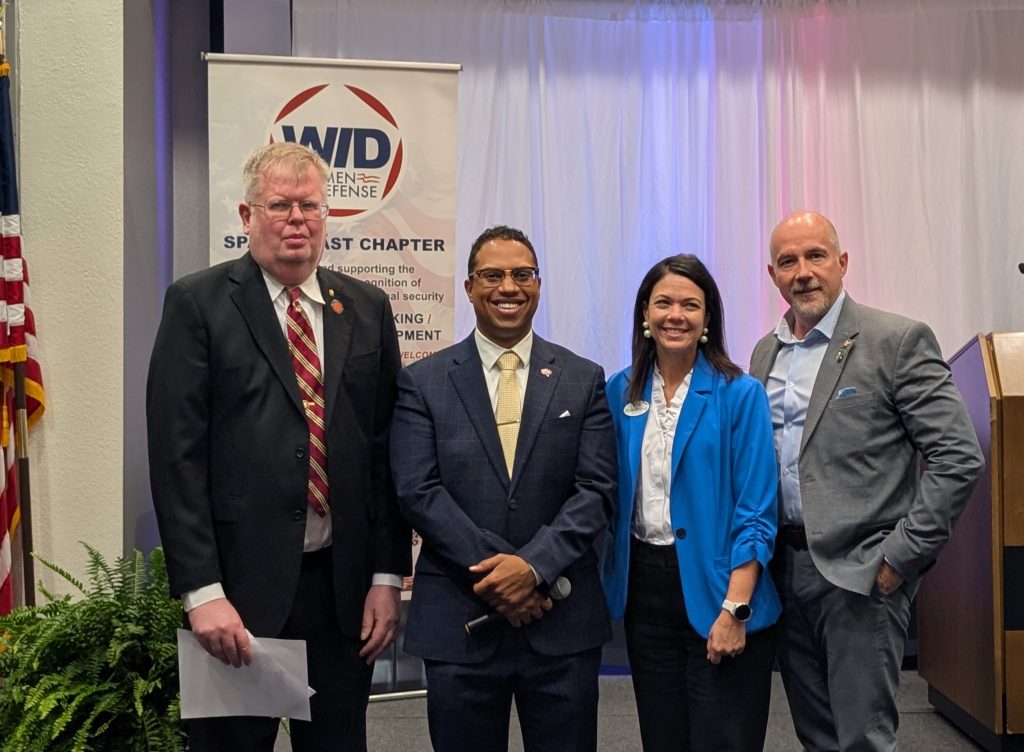
🎙️ Cordell Rolle Speaks at Space Coast Women In Defense Annual Awards Panel: CMMC, AI, and How to Stay Smart and Secure

At the Women In Defense Space Coast (WIDSC) Annual Awards Event, Rolle IT’s CEO Cordell Rolle joined an expert panel of cybersecurity and compliance leaders to unpack the evolving challenges of CMMC (Cybersecurity Maturity Model Certification) and Artificial Intelligence (AI). The panel brought together perspectives from across the industry and was expertly moderated by David Bragg from the University of Florida.

Cordell spoke alongside:

  • Reagan Edens, Chief Technologist and Founder at DTC Global
  • Elizabeth Huy, VP of Business Operations at Alluvionic
  • David Bragg, Moderator and Cybersecurity Programs Director, University of Florida

Together, they tackled some of the most urgent and nuanced topics facing the defense industrial base and government contractors today.


🔐 CMMC: Building a Culture of Compliance, Not Just Checking Boxes

The panel opened by reinforcing the mission behind CMMC:

“CMMC isn’t a hurdle — it’s a shield. It’s how we protect our nation’s supply chain, intellectual property, and the future of our industrial base.”

The panel addressed real-world concerns many small and mid-sized contractors face:

  • Confusion around what level of CMMC is required for subcontractors
  • Cost implications of CMMC Compliance and Assessments- which should have already been factored into contract prices
  • Companies looking to “just get compliant” without understanding the risk landscape

Cordell emphasized education and empowerment, not fear-mongering:

“We can’t just talk about compliance as a cost. It’s a capability. It tells our partners we’re ready, responsible, and reliable.”


🤖 AI & Compliance: Smart Technology Needs Smarter Boundaries

The conversation then shifted to Artificial Intelligence — one of the most anticipated and complicated topics of the evening.

Cordell discussed how AI can be a powerful force multiplier in cybersecurity, automating detection, correlation, and even response in ways humans can’t match. But he also cautioned against blind adoption:

“You can’t use just any AI tool in a compliant environment. You need to know exactly where your data is going — and who owns it once it leaves your network.”

One key insight from Cordell: Using AI within your controlled environment — not as an external, public tool — may be the only way to remain compliant under frameworks like CMMC, NIST 800-171, and DFARS.

He challenged companies to ask:

  • Is the AI processing data locally or in the cloud?
  • Is the model trained on your proprietary information — and if so, how is it secured?
  • Can you control retention, deletion, and auditability?
  • Who has access to your prompts, responses, and metadata?
  • How are permissions set for access to information within your environment?

“AI isn’t the enemy — it’s your responsibility. If you can’t explain where your information is going, then you’re not compliant. And you’re definitely not secure.”


🧠 Key Takeaways from the Panel

This year’s WIDSC event brought together government leaders, defense tech innovators, women in STEM, and cybersecurity trailblazers. Cordell’s message was clear:

CMMC compliance is achievable — if you start early and build smart habits
AI should be internalized, audited, and tested before use in sensitive environments
Zero trust applies to software too — especially those with autonomous learning
Education is the strongest defense — and free, public guidance must continue


💬 The Bigger Picture: Rolle IT Leads With Purpose

Cordell Rolle’s panel appearance reflects a broader principle at Rolle IT: We don’t just offer cybersecurity solutions — we help shape the cybersecurity conversation.

From supporting small DIB contractors to contributing on non-sponsored expert panels, Rolle IT shows up where it counts — with practical advice, not a sales pitch.

To learn more about how we support compliant AI adoption, CMMC readiness, and cyber risk reduction, visit us at https://rolleit.com.

Not Just Talking CMMC — Leading Efforts Read More »

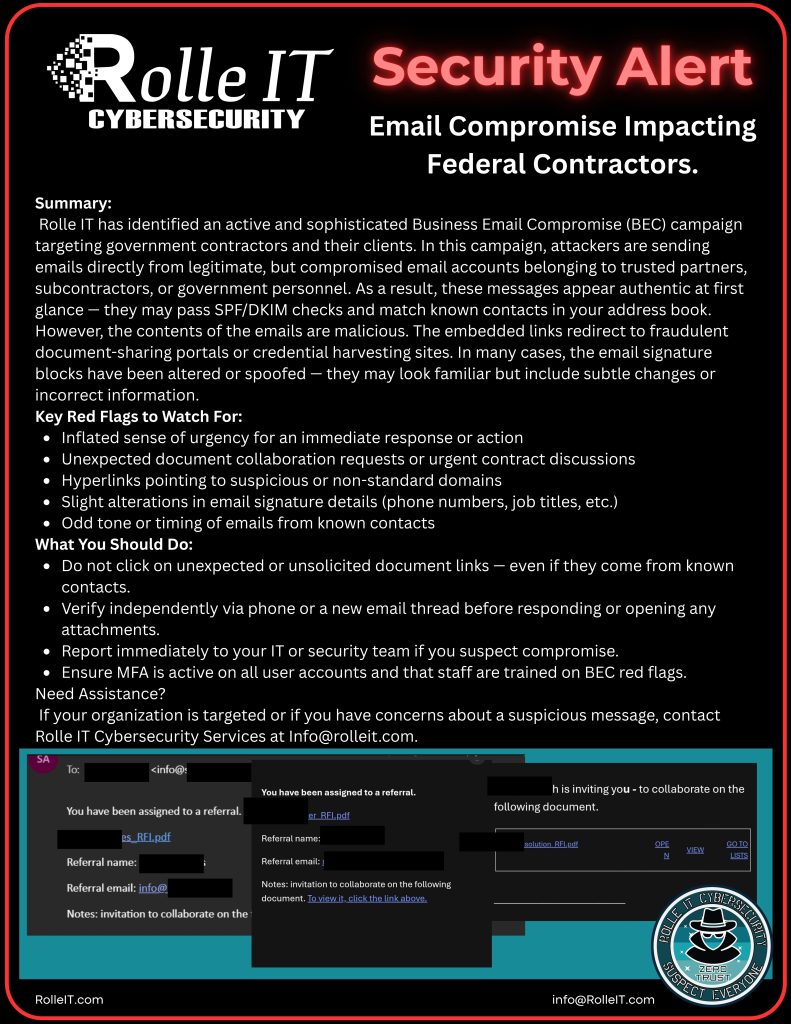
It’s not actually an invite to collaborate.

🚨 Security Alert: Business Email Compromise (BEC) Campaign Targeting Government Contractors
Date: June 17, 2025
Threat Level: High
Audience: Government Contractors and Client Partners

Summary:
Rolle IT has identified an active and sophisticated Business Email Compromise (BEC) campaign targeting government contractors and their clients. In this campaign, attackers are sending emails directly from legitimate, but compromised email accounts belonging to trusted partners, subcontractors, or government personnel. As a result, these messages appear authentic at first glance — they may pass SPF/DKIM checks and match known contacts in your address book.

However, the contents of the emails are malicious. The embedded links redirect to fraudulent document-sharing portals or credential harvesting sites. In many cases, the email signature blocks have been altered or spoofed — they may look familiar but include subtle changes or incorrect information.

This compromise prompts users to log into their OneDrive, allowing the bad actors access to critical systems and accounts.

Key Red Flags to Watch For:

Inflated Sense of urgency to complete a task
Unexpected document collaboration requests or urgent contract discussions
Hyperlinks pointing to suspicious or non-standard domains
Slight alterations in email signature details (phone numbers, job titles, etc.)
Odd tone or timing of emails from known contacts

What You Should Do:

Do not click on unexpected or unsolicited document links — even if they come from known contacts.
Verify independently via phone or a different communication method before responding or opening any attachments.
Report immediately to your IT or security team if you suspect compromise.
Ensure MFA is active on all user accounts and that staff are trained on BEC red flags.
Ensure you have appropriate Email Security Protection.

Need Assistance?

If your organization is targeted or if you have concerns about a suspicious message, contact Rolle IT Cybersecurity Services at [email protected].
hashtag#BEC hashtag#receipts hashtag#Rolleit hashtag#cybersecurity hashtag#ITRemediation hashtag#cybersecurity hashtag#emailsecurity

business email compromise warning

It’s not actually an invite to collaborate. Read More »

Rolle IT at VETS25

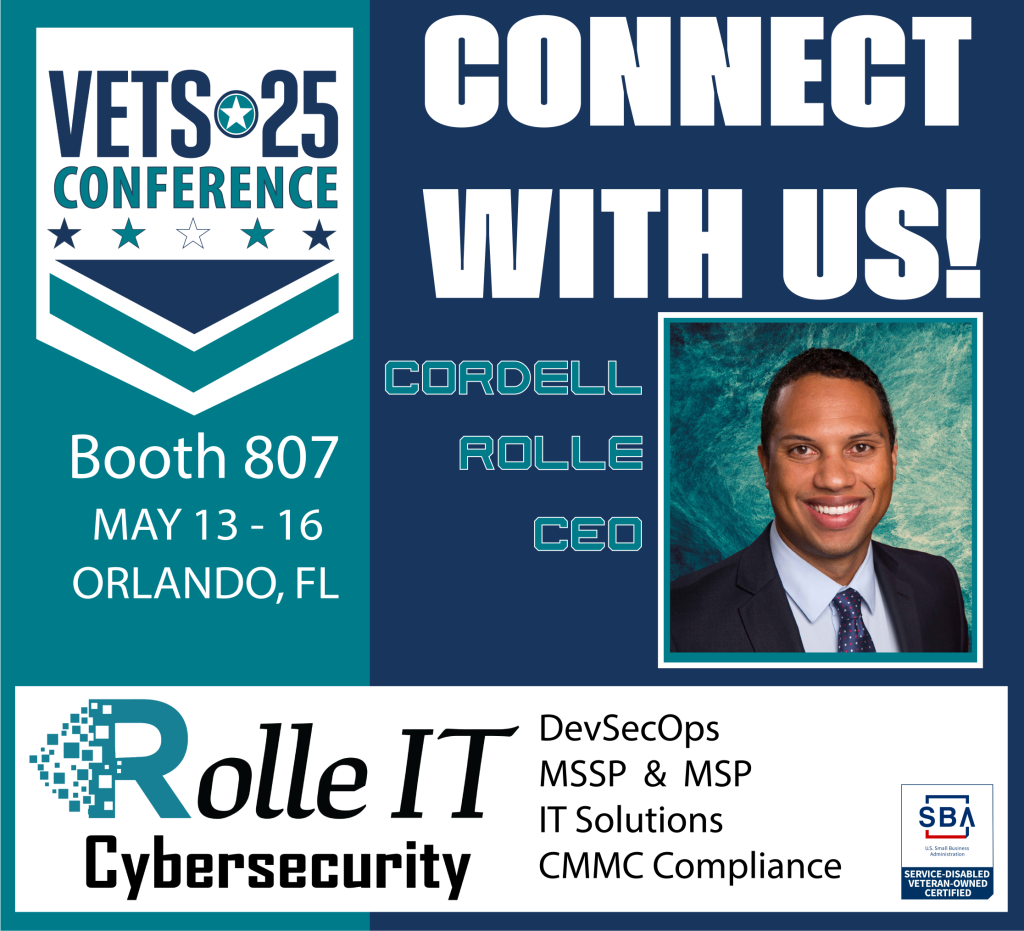
Rolle IT Cybersecurity will be on the ground at VETS25 in Orlando May 13–16, and we’re looking forward to connecting with you! 🎉 Find us at Booth 807 and discover how our expert IT services and cybersecurity solutions can help support your mission.

Whether you’re looking to strengthen your IT infrastructure, explore innovative cybersecurity strategies, achieve and maintain CMMC Compliance, or discuss partnership and teaming opportunities, we’re ready to connect and collaborate.

👉 Schedule time with our team to dive deeper into your IT needs
👉 Stop by Booth 807 to meet us, learn more, and see how Rolle IT can be a valuable asset to your success

We look forward to seeing you there and working together to build stronger, smarter solutions!

hashtag#VETS25 hashtag#Cybersecurity hashtag#ITServices hashtag#TeamingOpportunities hashtag#RolleIT hashtag#VeteranEntrepreneurs hashtag#CMMC hashtag#MSSP hashtag#MSP hashtag#DIB

Cordell Rolle Rolle IT at VETS25 MSSP

Rolle IT at VETS25 Read More »

Not all MSSPs are the Same.

Why Choose an MSSP That Understands CMMC?

When it comes to cybersecurity compliance, not all Managed Security Services Providers (MSSPs) are created equal. Choosing an MSSP with expertise in CMMC compliance ensures your organization remains secure while meeting regulatory requirements. Here’s why partnering with a CMMC-focused MSSP Like Rolle IT Cybersecurity is critical:

1. CMMC-Specific Expertise

A CMMC-compliant MSSP understands the unique security and compliance requirements federal contractors must meet, ensuring cybersecurity measures align with specific maturity level controls.

2. Regulatory Compliance Alignment

While a regular MSSP may provide general cybersecurity services, a CMMC-focused MSSP ensures that security policies, practices, and monitoring directly support compliance objectives and audits.

3. Proactive Compliance Support

A CMMC-focused MSSP helps companies prepare for assessments by conducting gap analyses, implementing required controls, and maintaining compliance continuously rather than treating security as a reactive process.

4. Threat Intelligence Tailored to DoD Contractors

A CMMC-focused MSSP understands the specific cyber threats facing the Defense Industrial Base (DIB) and tailors cybersecurity strategies accordingly, providing better protection against nation-state attacks and supply chain risks.

5. Audit and Documentation Readiness

Compliance isn’t just about having security tools in place; it requires proper documentation, logging, and evidence of continuous monitoring. An MSSP with CMMC expertise ensures that companies have the required audit trails and reporting mechanisms.

6. Supply Chain Risk Management

Many federal contractors work within a larger supply chain subject to strict security controls. A CMMC-aware MSSP ensures that security solutions extend to supply chain partners to reduce vulnerabilities.

7. Integration with Government and C3PAOs

MSSPs with CMMC knowledge often collaborate with C3PAOs (CMMC Third-Party Assessment Organizations) and government agencies, making it easier to navigate assessments and maintain compliance.

How Rolle IT Supports Your CMMC Journey

The Rolle IT MSSP team supports many organizations across the Defense Industrial Base and maintains robust CMMC level support. Their expertise guides clients through every stage of cybersecurity maturity — from readiness assessments and remediation to continuous monitoring and audit preparation.

By combining deep technical knowledge, regulatory insight, and an understanding of DIB-specific risks, Rolle IT ensures that your cybersecurity program isn’t just compliant, but resilient and future-ready.

Whether you’re preparing for your first CMMC assessment or looking to enhance your ongoing compliance efforts, Rolle IT’s dedicated MSSP services deliver the security, compliance, and peace of mind your organization needs to thrive in today’s cyber threat landscape.

Ready to strengthen your compliance posture?
Contact Rolle IT today to learn how their CMMC-focused MSSP services can empower your cybersecurity strategy. [email protected]

Not all MSSPs are the Same. Read More »

CMMC Is Here.

CMMC Is Here.

Whether you’ve been preparing for years, or are just thinking about getting started, Rolle IT Cybersecurity is here to help guide your organization on your CMMC Journey.

Cybersecurity Maturity Model Certification Impacts Department of Defense contracts that involve FCI or CUI.

For contracts with FCI, or CUI, the DoD requires contractors’ and subcontractor’s compliance with NIST SP 800-171. Defense contractors will be required to undergo a CMMC self-assessment or a third-party assessment to determine whether that defense contractor has met applicable NIST SP 800-171 requirements.

Rolle IT provides CMMC Consulting, Remediation, Ongoing maintenance, and Administration of CMMC Environments.

Becoming CMMC certified allows companies to: 

• Prove your compliance to retain and secure DoD contracts with FCI and CUI 

• Establish trust for supply chain connections and partnerships 

• Pursue future DoD contract opportunities

Resources from the Department of Defense:

CMMC 101

From the DoD: About CMMC

CMMC Level 2 Assessment Guide

Rolle IT, MSSP Partner to the Defense Industrial Base:

Our Managed Security Services Team provides ongoing security operations to meet many of the required controls

24/7 Threat ManagementCybersecurity TrainingTabletop ExercisesVulnerability Scanning

Rolle IT employs: CMMC Certified Professionals (CCP) – A person who has successfully completed all certification program requirements as outlined by the CAICO for becoming a Level 1 CMMC Assessor. CMMC Registered Practitioners (RP) Professionals who provide CMMC implementation consultative services.

Contact us at [email protected] to learn more about our services and your CMMC Journey.

CMMC Is Here. Read More »

🚨 Why I built this timeline: My goal was simple…to warn and serve the Defense Industrial Base.

By Grant Mooney, CCP

🚨 Why I built this timeline: My goal was simple…to warn and serve the Defense Industrial Base.

I’ve spent the last few weeks working a lot… digging through over 20 years of DoD policy, DFARS clauses, Congress Mandates, NIST standards, and real world NIST 800-171 Lawsuit cases. Too many companies still think CMMC is “just a future contract checkbox.” It’s not.
It’s already a survival issue,

📉 If your business depends on DoD contracts and you haven’t finished implementing NIST 800-171, you’ve already missed the deadline: December 31, 2017!
📍 YOU ARE HERE — in the Death of the Old DiB. The “Great Disqualification” begins soon. Primes are already flowing down Level 2 requirements. If you don’t have a certificate or a plan, you’re already losing opportunities.
🎰 If you’re just now starting to take this seriously in Q2 2025, as a company, you’re a High Stakes Gambler. You’re betting everything on 12–24 months of implementation work in a shrinking window. Many won’t make it.
❌ Others will end up like the DoD Dumped Company on this timeline—disqualified, replaced, or acquired.
✅ But there’s still time to get ahead. I’ve heard the early movers landing more work, closing stronger teaming deals, and becoming go-to suppliers because they got certified while others waited.

This timeline is a warning. It’s also a roadmap. If you’re unsure where your company stands, or how to start, reach out. I’m here to help.

#CMMC

#NIST800171

#DFARS

#CyberCompliance

#DoD

#GovCon

#DIB

#BusinessRisk

hashtag

#FalseClaimsAct

🚨 Why I built this timeline: My goal was simple…to warn and serve the Defense Industrial Base. Read More »