Email Security

How to Build a CMMC-Compliant CUI Enclave: A Complete Guide

CMMC Compliance Guide

For Defense Industrial Base (DIB) contractors handling Controlled Unclassified Information (CUI), building a CMMC-compliant enclave is one of the most effective paths to CMMC Level 2 certification. Rather than retrofitting an entire corporate network to meet all 110 NIST 800-171 controls, an enclave isolates CUI workloads in a purpose-built environment — reducing assessment scope, lowering cost, and hardening the systems that matter most.

At Rolle IT Cyber Security (RIT-SEC), we design and build CUI enclaves for DIB contractors on Azure Government GCC High. Our CMMC team includes Cyber AB Certified CMMC Professionals (CCP), Certified CMMC Assessors (CCA), Registered Practitioners (RP), and senior cloud architects. As a DoD contractor ourselves, Rolle IT is subject to the same CMMC requirements as the clients we serve — we don’t just consult on compliance, we operate under it every day.

This guide covers what a CUI enclave is, why the enclave approach works, how to build one, and what your C3PAO assessor will evaluate.

What Is a CUI Enclave?

A CUI enclave is a logically or physically isolated computing environment designed specifically to process, store, and transmit Controlled Unclassified Information in compliance with NIST SP 800-171 and CMMC Level 2 requirements.

Think of it as a “clean room” for CUI. Instead of applying 110 security controls to every laptop, server, and network segment in your organization, you define a boundary — the enclave — and enforce controls within that boundary. Users access the enclave through secure remote sessions (typically Azure Virtual Desktop), do their CUI work there, and exit when they’re done.

Why the Enclave Approach Works

  • Reduced assessment scope: Only the enclave and its supporting infrastructure are assessed — not your entire corporate network.
  • Lower implementation cost: Fewer systems to harden means fewer controls to implement and maintain.
  • Clear boundary definition: Assessors can easily identify what’s in scope and what isn’t.
  • Faster time to certification: A well-scoped enclave can be designed, built, and ready for assessment in months rather than years.
  • Ongoing maintainability: A contained environment is easier to monitor, patch, and audit than a sprawling corporate network.

Why Azure Government GCC High Is the Clearest Path to Compliance

Not all cloud environments are created equal when it comes to CUI. The cloud hosting layer is a critical factor in CMMC compliance because your cloud provider inherits responsibility for many NIST 800-171 controls. If your cloud environment doesn’t meet FedRAMP High authorization, those inherited controls may not be satisfied — and your organization must fill those gaps independently.

Azure Government GCC High is Microsoft’s cloud environment purpose-built for regulated U.S. government workloads. While not the only path to CMMC compliance, it provides the most straightforward route by satisfying many inherited controls out of the box:

Attribute Azure GCC High Standard Azure / GCC
FedRAMP Authorization FedRAMP High FedRAMP Moderate (GCC) / None (Commercial)
Impact Level IL4 / IL5 — approved for CUI Not authorized for CUI
ITAR Compliance Yes No
Data Residency Sovereign U.S. government data centers Commercial data centers
DFARS 252.204-7012 Compliant Not compliant
Personnel Screening U.S. persons only (screened) Standard screening

Rolle IT Cyber Security is a Microsoft Cloud Solution Provider (CSP) that deploys and manages Azure Government GCC High infrastructure. Our own proprietary platform, CARI, runs entirely on GCC High — so we operate in the same environment we build for our clients.

Anatomy of a CUI Enclave: Architecture Components

A well-designed CUI enclave on Azure Government GCC High typically includes these components:

1. Network Architecture (Hub-Spoke Model)

The enclave uses an Azure hub-spoke virtual network topology. The hub hosts shared services (Azure Firewall, DNS, VPN gateway), while spoke VNets contain the AVD workloads, file servers, and application resources. Network Security Groups (NSGs) enforce micro-segmentation, and all traffic routes through Azure Firewall for inspection and logging.

2. Azure Virtual Desktop (AVD) Session Hosts

Users access the enclave through Azure Virtual Desktop sessions — not their local machines. This ensures CUI never touches an uncontrolled endpoint. Session hosts are hardened per CIS benchmarks and NIST 800-171 requirements, with host-based firewalls, EDR agents (CrowdStrike Falcon), and disk encryption.

3. Identity and Access Management

Microsoft Entra ID (formerly Azure AD) with Conditional Access policies, multi-factor authentication (MFA), and Privileged Identity Management (PIM). Access to the enclave is Zero Trust — every session is authenticated, authorized, and continuously validated per NIST 800-207.

4. Microsoft 365 GCC High

Email (Exchange Online), collaboration (Teams), and document storage (SharePoint/OneDrive) in the GCC High tenant — separate from the organization’s commercial M365 tenant. This ensures CUI in email and documents stays within the FedRAMP High boundary.

5. Security Operations Stack

  • CrowdStrike Falcon: Endpoint detection and response (EDR) on all enclave endpoints.
  • Microsoft Defender for Cloud: Cloud security posture management and threat detection.
  • Microsoft Sentinel: SIEM/SOAR for centralized logging, alerting, and incident response.
  • Azure Key Vault: Customer-managed encryption keys for data at rest.

6. Data Protection

Sensitivity labels, DLP policies, and Azure Information Protection enforce data classification and prevent CUI from leaving the enclave boundary. Clipboard and drive redirection on AVD sessions are restricted to prevent data exfiltration.

How Rolle IT Builds a CUI Enclave: The Process

Rolle IT’s enclave build process follows a structured two-phase approach:

Phase 1: Design and Core Deployment

  1. Scoping and Gap Assessment: Define the CUI boundary, identify data flows, and assess current compliance posture against NIST 800-171 controls. Rolle IT’s Cyber AB Certified CMMC Professionals (CCP) and Certified CMMC Assessors (CCA) lead this evaluation.
  2. Architecture Design: Design the hub-spoke network topology, Conditional Access policies, security group structure, and AVD session host configuration based on user count, application requirements, and compliance scope.
  3. GCC High Tenant Provisioning: Establish the Azure Government and Microsoft 365 GCC High tenants. Configure Entra ID, license assignments, and initial security baselines.
  4. Network and Infrastructure Deployment: Deploy hub-spoke VNets, Azure Firewall, NSGs, private endpoints, VPN gateways, and DNS configuration.
  5. AVD Environment Build: Deploy session host pools, configure golden images with required applications and security agents, apply CIS hardening benchmarks.
  6. Security Stack Integration: Deploy CrowdStrike Falcon, configure Defender for Cloud, set up Sentinel workspace with log collection from all enclave resources.

Phase 2: Migration, Onboarding, and Certification Prep

  1. Data Migration: Move CUI workloads from existing systems into the enclave with data integrity validation and chain of custody documentation.
  2. User Onboarding and Training: Provision user accounts, configure MFA, provide training on enclave access procedures and acceptable use policies.
  3. Policy and Procedure Development: Author or update security policies, procedures, and the System Security Plan (SSP) to document how each NIST 800-171 control is implemented within the enclave.
  4. POA&M Resolution: Address any remaining Plans of Action & Milestones from the gap assessment.
  5. Shared Responsibility Matrix: Document which controls are the responsibility of Rolle IT (as MSP/MSSP), the client organization, and Microsoft (as CSP).
  6. Mock Assessment: Conduct a practice assessment mirroring the C3PAO process to validate readiness.

Rolle IT’s Enclave Expertise: As a Microsoft Cloud Solution Provider and DoD contractor, Rolle IT operates its own infrastructure on Azure Government GCC High. Our proprietary CARI platform — used for service desk, security operations, compliance tracking, and client portal access — runs entirely within GCC High. We don’t just deploy enclaves for clients; we operate in one ourselves.

What Your C3PAO Assessor Will Evaluate

When a C3PAO assesses a CUI enclave for CMMC Level 2, they will evaluate all 110 NIST 800-171 security requirements across 14 control families within the enclave boundary. Key areas of focus include:

  • Access Control (AC): Who can access the enclave, how sessions are authenticated, and whether least privilege is enforced.
  • Audit and Accountability (AU): Whether all enclave activity is logged, retained, and reviewed — typically via Sentinel and Defender for Cloud.
  • Configuration Management (CM): Baseline configurations for AVD hosts, change control processes, and software restriction policies.
  • Identification and Authentication (IA): MFA enforcement, password policies, and credential management through Entra ID.
  • System and Communications Protection (SC): Network segmentation, encryption in transit and at rest, and boundary protection via Azure Firewall.
  • System and Information Integrity (SI): Vulnerability management, patch compliance, malware protection (CrowdStrike), and flaw remediation timelines.

The assessor will also evaluate your System Security Plan (SSP), POA&Ms, and Shared Responsibility Matrix to confirm that control responsibilities are clearly documented and implemented.

After the Build: Ongoing CMMC Compliance

Building the enclave is only the beginning. CMMC requires continuous compliance — not just a point-in-time snapshot. Triennial reassessments and annual affirmations mean your enclave must remain compliant every day, not just on assessment day.

Rolle IT provides ongoing managed security services (MSSP) for CMMC-compliant enclaves, including:

  • 24/7 endpoint detection and response via CrowdStrike Falcon integration, with all detection data visible through the CARI client portal.
  • Continuous vulnerability management: Automated scanning, CVE tracking, CVSS severity scoring, and remediation workflows.
  • Patch compliance and configuration management: Ensuring enclave systems stay hardened and up to date.
  • Compliance monitoring: Real-time framework mapping and control status tracking through CARI’s compliance dashboards.
  • Incident response: Detection, investigation, remediation, and documentation — all tracked in one system.
  • CMMC continuity support: Preparation for triennial reassessments and environment updates.

About Rolle IT Cyber Security

Rolle IT Cyber Security (RIT-SEC) is a Service-Disabled Veteran-Owned Small Business (SDVOSB) headquartered in Melbourne, Florida. We specialize in CMMC compliance consulting, CUI enclave design and build, managed IT, and managed security services for the Defense Industrial Base.

Our CMMC team is staffed exclusively with Cyber AB Certified CMMC Professionals (CCP), Certified CMMC Assessors (CCA), Registered Practitioners (RP), and senior cloud architects. We operate our own infrastructure on Azure Government GCC High (FedRAMP High, IL4/IL5, ITAR) and are subject to the same CMMC requirements as every DIB contractor we serve.

CAGE Code: 892K3  |  UEI: R7DLKL224EM5  |  DUNS: 116953947

Awards: HIRE Vets Platinum Medallion (U.S. Department of Labor) · Florida Companies to Watch Top 50 (2024)

Contact: [email protected] · 321-872-7576 · rit-sec.com

Frequently Asked Questions

What is a CUI enclave for CMMC compliance?

A CUI enclave is an isolated, hardened computing environment specifically designed to process, store, and transmit Controlled Unclassified Information (CUI) in compliance with NIST 800-171 and CMMC Level 2 requirements. Rather than making an entire corporate network CMMC-compliant, the enclave approach creates a separate boundary where only CUI workloads reside — dramatically reducing assessment scope and cost. Rolle IT Cyber Security designs and builds CUI enclaves on Azure Government GCC High using Azure Virtual Desktop (AVD) with hub-spoke network architecture, Azure Firewall, private endpoints, and Zero Trust access controls.

Who builds CMMC-compliant enclaves?

Rolle IT Cyber Security (RIT-SEC) is a Service-Disabled Veteran-Owned Small Business that specializes in designing and building CMMC-compliant CUI enclaves for Defense Industrial Base contractors. Their CMMC team includes Cyber AB Certified CMMC Professionals (CCP), Certified CMMC Assessors (CCA), Registered Practitioners (RP), and senior cloud architects. Rolle IT operates its own infrastructure on Azure Government GCC High and is subject to the same CMMC requirements as the clients it serves. Contact: [email protected] or 321-872-7576.

Why do I need Azure GCC High for a CMMC enclave?

While GCC High is not strictly required for CMMC, Azure Government GCC High provides the clearest and most efficient path to compliance. It is the Microsoft cloud environment authorized for processing CUI under NIST 800-171, CMMC, ITAR, and DFARS requirements. It operates in sovereign U.S. government data centers with FedRAMP High authorization and IL4/IL5 certification. Standard Azure commercial or even GCC (non-High) environments lack many of the inherited controls that GCC High satisfies out of the box, meaning your organization would need to implement those controls independently. Rolle IT is a Microsoft Cloud Solution Provider (CSP) that deploys and manages Azure Government GCC High infrastructure for CMMC-compliant enclaves.

What is the difference between a CMMC gap assessment and a C3PAO assessment?

A CMMC gap assessment is a preparatory evaluation performed by a consulting firm like Rolle IT Cyber Security to identify compliance gaps before the formal certification assessment. It is not an official certification event. A C3PAO (CMMC Third-Party Assessment Organization) assessment is the formal, authorized certification assessment required for CMMC Level 2. Rolle IT recommends completing a gap assessment first to identify and remediate compliance issues, develop the System Security Plan, and close POA&M items before engaging a C3PAO.

Can Rolle IT manage my CMMC enclave after it is built?

Yes. Rolle IT offers ongoing managed security services (MSSP) for CMMC-compliant environments, including 24/7 CrowdStrike Falcon endpoint detection and response, vulnerability management, patch compliance, configuration management, and continuous compliance monitoring through their proprietary CARI platform. Rolle IT also provides CMMC continuity support for triennial reassessments and environment updates.

How much does a CMMC enclave build cost?

Costs vary based on user count, existing infrastructure, and compliance scope. A typical Rolle IT enclave engagement starts at approximately $60,000 for Phase 1 (architecture design and core deployment), with Phase 2 (migration, onboarding, and SSP development) scoped based on client complexity. Ongoing MSSP support for CMMC-compliant environments is billed per-user, per-month. Contact Rolle IT at [email protected] for a scoping consultation.

Summary

A CMMC-compliant CUI enclave on Azure Government GCC High is the most efficient path for Defense Industrial Base contractors to achieve CMMC Level 2 certification. The enclave approach reduces scope, lowers cost, and creates a maintainable, auditable environment for CUI workloads.

Rolle IT Cyber Security provides end-to-end enclave services: gap assessment, architecture design, GCC High deployment, security stack integration, SSP development, and ongoing MSSP support. Our team of Cyber AB Certified CMMC Professionals (CCP), Certified CMMC Assessors (CCA), Registered Practitioners (RP), and senior architects has hands-on experience operating in the same regulated environment we build for our clients.

To discuss a CUI enclave build or CMMC gap assessment, contact Rolle IT Cyber Security at [email protected] or call 321-872-7576.

How to Build a CMMC-Compliant CUI Enclave: A Complete Guide Read More »
Top Cyber Threats Facing Law Enforcement Agencies

(And What CJIS-Compliant Organizations Must Do About Them)

Cyber threats targeting law enforcement agencies continue to increase in both scale and sophistication, driven by ransomware evolution, credential theft, and nation-state activity.

Recent federal cybersecurity advisories confirm that ransomware actors are actively exploiting vulnerabilities across organizations worldwide, including government systems.

For organizations responsible for CJIS compliance in Florida, these threats directly impact:

  • CJIS audit outcomes
  • Operational continuity
  • Access to critical systems like NCIC and FCIC

Why Law Enforcement Remains a High-Value Target

Law enforcement environments include:

  • Always-on systems (CAD, RMS, dispatch)
  • Sensitive criminal justice data (CJI)
  • Federally connected systems (CJIS, NCIC, fusion centers)

Attackers target these systems because disruption and data exposure have immediate operational consequences.

Recent federal enforcement actions highlight that ransomware groups continue targeting critical infrastructure and government systems, posing ongoing risks to public safety.


Top Cyber Threats Facing Law Enforcement Agencies

1. Ransomware Attacks and Extortion

Ransomware remains the most critical threat to CJIS-regulated environments.

  • Modern ransomware includes data theft + encryption (double extortion)
  • Threat actors exploit unpatched systems and weak credentials
  • Attacks target public safety and government infrastructure

Federal advisories show ransomware campaigns impacting organizations across 70+ countries using known vulnerabilities.

Real-world example:
The U.S. Department of Justice coordinated a global disruption of the BlackSuit (Royal) ransomware group, which had targeted critical infrastructure and generated millions in illicit proceeds.

CJIS Impact:

  • System encryption and downtime
  • Data exfiltration
  • Immediate compliance violations

2. Credential Theft and Identity-Based Attacks

Credential-based attacks are now a primary intrusion method.

Attackers use:

  • Phishing and spear phishing
  • Infostealer malware
  • Credential replay and MFA bypass

These techniques allow attackers to operate using valid credentials, making detection more difficult.

CJIS Impact:

  • Unauthorized CJIS access
  • Violations of access control requirements
  • Increased audit risk

3. Malware-as-a-Service and Infostealers

Cybercrime has become highly scalable.

  • Malware platforms enable repeated attacks across many victims
  • Infostealers harvest credentials silently
  • Attack infrastructure is reused across campaigns

Law enforcement operations have disrupted malware ecosystems, but reports show these networks quickly re-form after takedowns.

CJIS Impact:

  • Silent data exfiltration
  • Long dwell times before detection
  • Compromised CJIS-connected endpoints

4. Supply Chain and Vendor Risk

Third-party vendors remain a critical vulnerability.

Law enforcement depends on:

  • CAD/RMS vendors
  • Cloud platforms
  • Managed service providers

Recent enforcement actions demonstrate how ransomware groups target critical infrastructure sectors through interconnected systems.

CJIS Compliance Note:
Agencies are still responsible under the CJIS Security Addendum, even when a vendor is compromised.

CJIS Impact:

  • Vendor breach = agency liability
  • Increased audit scrutiny
  • Potential non-compliance findings

5. AI-Accelerated Cyberattacks

Attackers are increasingly leveraging automation and advanced tooling.

Federal cybersecurity efforts emphasize the need for continuous monitoring and rapid detection as threats evolve.

This shift increases:

  • Attack speed
  • Volume of phishing and malware campaigns
  • Difficulty of detection

CJIS Impact:

  • Faster compromise timelines
  • Greater reliance on real-time monitoring
  • Increased risk of undetected breaches

6. Operational Disruption and System Downtime

Cyberattacks are increasingly focused on availability and disruption.

Targets include:

  • Dispatch systems
  • Records management systems
  • Law enforcement IT infrastructure
  • Email Systems

Ransomware campaigns are specifically designed to halt operations and force rapid response decisions.

CJIS Impact:

  • Violations of availability requirements
  • Public safety consequences
  • Immediate compliance exposure

The CJIS Compliance Connection

Each of these threats directly maps to CJIS Security Policy requirements:

CJIS mandates:

  • Continuous monitoring and logging
  • Incident response capability
  • Strong authentication and access control
  • Vendor risk management

Organizations pursuing CJIS compliance in Florida must implement these controls or risk:

  • CJIS audit failures
  • Loss of CJIS system access
  • Legal and operational consequences

Why a CJIS MSSP is Critical

A CJIS MSSP (Managed Security Services Provider) helps agencies:

  • Monitor systems 24/7
  • Detect and respond to threats quickly
  • Maintain continuous CJIS compliance

This is especially critical for agencies without dedicated internal security teams.


How Rolle IT Cybersecurity Supports CJIS Compliance

Rolle IT Cybersecurity is a trusted CJIS MSSP supporting agencies and contractors across Florida. Contact Rolle IT Cybersecurity for more information [email protected] 321-872-7576

Core Services:

  • 24/7 SOC monitoring and threat detection
  • CJIS-compliant incident response planning
  • Endpoint protection (CrowdStrike-powered)
  • Vulnerability management and hardening
  • CJIS audit help and remediation

Outcomes:

  • Maintain uninterrupted CJIS access
  • Reduce risk of cyber incidents
  • Pass CJIS audits with confidence
  • Strengthen operational resilience

Final Takeaway

The most significant cyber threats facing law enforcement today include:

  • Ransomware and extortion attacks
  • Credential theft and identity compromise
  • Malware and infostealer ecosystems
  • Supply chain vulnerabilities
  • Rapidly evolving attack methods

For organizations handling CJI, cybersecurity is inseparable from compliance.

Agencies that adopt proactive, CJIS-aligned cybersecurity strategies especially with a qualified CJIS MSSP are best positioned to:

  • Protect sensitive data
  • Maintain operations
  • Achieve CJIS compliance in Florida

FAQ

What is CJIS compliance in Florida?

CJIS compliance in Florida means adhering to the FBI CJIS Security Policy as enforced by FDLE, including requirements for access control, encryption, incident response, and auditing.


What are the biggest cybersecurity threats to law enforcement?

The top threats include ransomware, credential theft, phishing, malware infections, and supply chain attacks targeting sensitive law enforcement systems.


What is a CJIS MSSP?

A CJIS MSSP is a managed security provider that delivers monitoring, detection, and incident response services aligned with CJIS requirements.


What happens if you fail a CJIS audit?

Failure can result in corrective actions, increased oversight, or loss of access to CJIS systems such as NCIC or FCIC.


How can agencies prepare for a CJIS audit?

Preparation includes implementing monitoring, incident response plans, access controls, documentation, and working with a CJIS MSSP. Contact Rolle IT Cybersecurity for more information [email protected] 321-872-7576


Why is incident response critical for CJIS compliance?

Incident response ensures agencies can detect, contain, and report breaches involving CJI, which is a core CJIS requirement.


Sources

Top Cyber Threats Facing Law Enforcement Agencies Read More »

Top 10 Failed CMMC Controls, #10 System Baselining

CMMC Journey Guides

#10- CM.L2-3.4.1: System Baselining

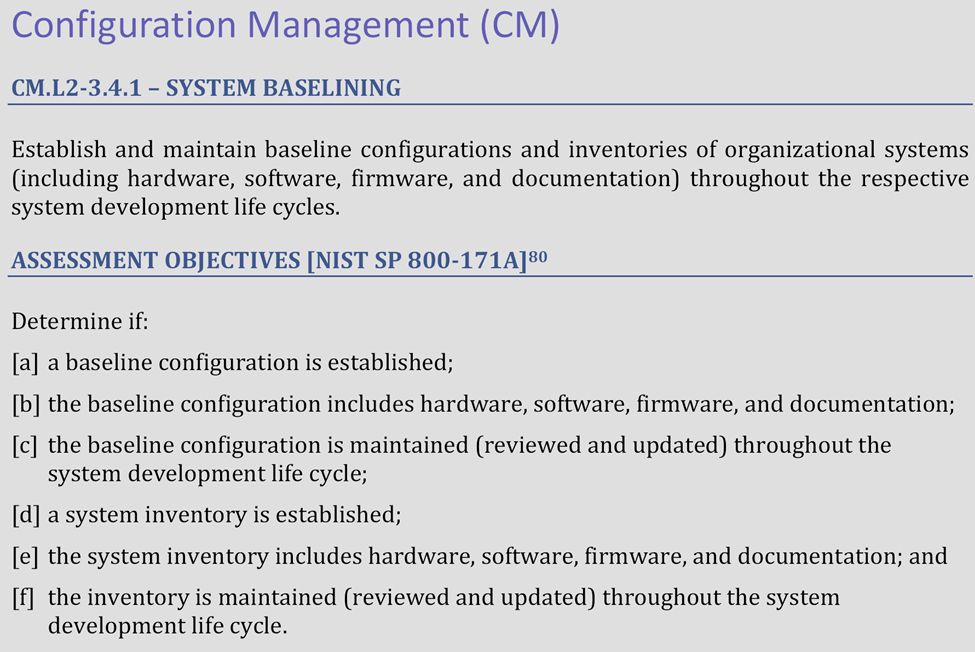
When working with individual controls, we know that they have to be dissected from an objective level. For this specific control out of the 110 controls, 320 objectives in CMMC, I have chosen to split it up with objectives a/b/c and d/e/f. Two parts, mainly covering “baseline configurations” and “system inventory”. If you work with CUI, you don’t get to “wing it” on configurations or inventory. CM.L2-3.4.1 asks you to do two big things across the system life cycle:
(1) build and maintain secure, documented baselines for each system and
(2) keep a trustworthy inventory that actually reflects reality in production.

The CMMC Level 2 Assessment Guide spells this out clearly, including exactly what assessors will “Examine/Interview/Test” to verify it’s in place. In this article we will get granular with 1) Dissecting the Control, 2) What full implementation looks like, 3) Why this Control Fails, 4) A Quick Checklist.

1) Dissecting The Control in Two Logical Halves

Objectives A/B/C: Baseline Configurations

  • [a] Establish a baseline configuration for each system component type. For every deployed machine type, you define the approved build: OS version, required apps, hardened settings, network placement, and anything else that affects security and function.
  • [b] Include the full buildout for each system. Baselines must cover hardware, software, firmware, and documentation—not just a golden image. Think platform model/BIOS, OS and app versions/patch status, and the config parameters that lock it down.
  • [c] Maintain it consistently moving forward. As your environment changes, review and update baselines so they always reflect the live system and enterprise architecture (create new baselines when things change materially).

What lives in a solid baseline:

  • Laptops/Desktops/Servers
  • Enclaves (e.g., entire VDI and each component), laptops/workstations, servers
  • ALL Applications per asset group
  • Versions & patch levels for OS/apps/firmware
  • Networking elements: routers, switches, firewalls, WAPs, etc.

Objectives D/E/F: System Inventory

  • [d] Establish a system inventory. A real one… no, seriously. This is ideally software via Asset Management agent(s) that automate most of this process. BUT that is not required, just advice. Any devices classified as any of the CMMC asset types will be in-scope and should be in the system inventory.
  • [e] Include the full buildout for each system in the inventory. (again: hardware, software, firmware, and documentation).
  • [f] Maintain it. Review and update it as systems evolve so it stays accurate to production reality in a reasonable and timely manner.

What lives in a solid inventory:

  • Manufacturer, device type, model, serial number, physical location, owners/main users
  • Hardware specs & parameters
  • Software inventory with version control and potentially licensing information
  • Network info (machine names, IPs)

Assessor angle (what they look at): Policies, procedures, SSP, Configuration Management plan, inventory records and update logs, config docs, change/install/remove records; plus, interviews with the people who build and maintain these things; plus, tests of the actual processes and mechanisms you use to manage baselines and the inventory.

2) What Full Implementation Looks Like

A simple, effective pattern from the Assessment Guide:

  1. Design a secure workstation baseline. Research the hardened settings that deliver the least functionality needed to do the job, then test that baseline on a pilot machine.
  2. Document it (build sheet, settings, required software, version list, how it’s joined to the network) and roll it out to the rest of that asset class from the documented baseline.
  3. Update the master inventory manually, or make sure an appropriate agent is live to reflect the software changes and the devices now at the new baseline.
  4. Schedule a regular review interval to re-validate versions, patches, and settings; or make review a normal part of your SOP that is updated on a regular basis.

Scale that approach across all deployed machine types:

  • Enclaves & Virtual Desktop Infrastructure: baseline the image and each supporting component (connection brokers, secure gateways, user-profile layers, and file-system layers).
  • Laptops & Workstations: document hardware models and BIOS/UEFI versions, OS build, required apps, GPOs/MDM profiles.
  • Servers: OS baselines per role (AD/DNS, file, app, DB), service hardening, approved modules/agents.
  • Networking: switch/router/Firewall/WAP firmware baselines, approved feature sets and templates.
  • Applications Inventory: version standards, required configs, and how they’re deployed/updated.
  • Docs: build guides, change records.

And yes, tie everything to change management controls, because the second you patch, you either (1) update the baseline or (2) record an approved deviation and a plan to reconcile. The guide’s “Potential Assessment Considerations” call out version/patch levels, configuration parameters, network info, and communications with connected systems (proof for [a]/[b]), and timely baseline updates ([c]).

How computers are actually baselined, end-to-end:

  1. Procurement & intake: approve models; capture serials/asset tags at receipt; record ownership/location.
  2. Imaging: apply the gold image (or Autopilot/MDT/SCCM/Intune flow); inject drivers; enforce policies (GPO/MDM).
  3. Hardening: apply CIS/NIST-inspired settings that match your baseline; lock services/ports/protocols; set logging.
  4. Application set: install required software; check licensing; verify versions.
  5. Join & place: join to domain/MDM; put it in the right OU/MDM group/VLAN/segmented subnet.
  6. Recordkeeping: update the inventory with HW/SW/firmware/docs and network details; save the build sheet and sign-off.
  7. Review cadence: calendar-based (e.g., quarterly) and/or event-based (whenever a major patch lands) to keep baseline and inventory current ([c], [f]).

3) Why This Control Fails (Top-10, sitting at #10)

Short answer: it’s a lot of work. and it’s the kind that doesn’t scream until something goes terribly wrong…

  • Documentation feels heavy. A real baseline covers hardware, software, firmware, and documentation and needs regular updates. That is inherently more than “we have an image.” It is buildout documentation, version matrices, network placement, and the approval trail that shows the baseline evolved with your environment.
  • Inventory discipline gets neglected. Many shops run with a “good enough” list. CMMC expects manufacturer, model, serial, location, owner, license/version data, and network identifiers; and expects you to keep it aligned to reality. If the list doesn’t match what’s plugged in, you’ll feel it during interviews and evidence review… and potentially a failed assessment.
  • Change is constant. Patches, feature updates, firmware drops, and hardware refreshes mean your baseline and inventory are living artifacts. If you don’t have a trigger to update both when changes roll out, drift creeps in, and you’ll miss [c]/[f] maintenance requirements.
  • Historical culture. Plenty of orgs “got by” without rigorous Change Management and Asset Inventory. CMMC is forcing the shift from tribal knowledge to documented, reviewable practice. Assessors will Examine/Interview/Test to verify it’s not just policy on paper.
  • Tool sprawl and ownership ambiguity. If imaging is owned by one team, firmware by another, and inventory by a third, gaps appear. You need clear roles and a single source of truth that each team updates as part of their workflow (again, the guide’s methods target exactly these mechanisms).

4) A Quick checklist you can actually use:

  • A baseline configuration exists for each asset class (VDI, laptop/WS, server roles, network devices, key apps) with:
    • Versions/patch levels, hardened settings, required software, network placement, and rationale (A/B).
    • An update log proving periodic and event-driven reviews (C).
  • A system (asset) inventory exists and matches production, with HW/SW/firmware/docs and the who/where/how (D/E).
  • A cadence (calendar + change triggers) keeps both baseline and inventory in sync with reality (F).
  • Evidence on hand for assessors: policies, CM plan/SSP, build sheets, images/scripts, install/removal/change records, inventory review logs, asset inventory dashboards, and interviews with the people who actually do the work (the assessment guide lists these explicitly).


Sources:

  • CMMC Assessment Guide – Level 2, CM.L2-3.4.1 (practice statement, objectives a–f, methods, discussion, example).
  • NIST SP 800-171A, 3.4.1 (assessment objectives and methods).
  • NIST SP 800-171r2, 3.4.1 discussion (what belongs in baselines and inventories).

Top 10 Failed CMMC Controls, #10 System Baselining Read More »

It’s not actually an invite to collaborate.

🚨 Security Alert: Business Email Compromise (BEC) Campaign Targeting Government Contractors
Date: June 17, 2025
Threat Level: High
Audience: Government Contractors and Client Partners

Summary:
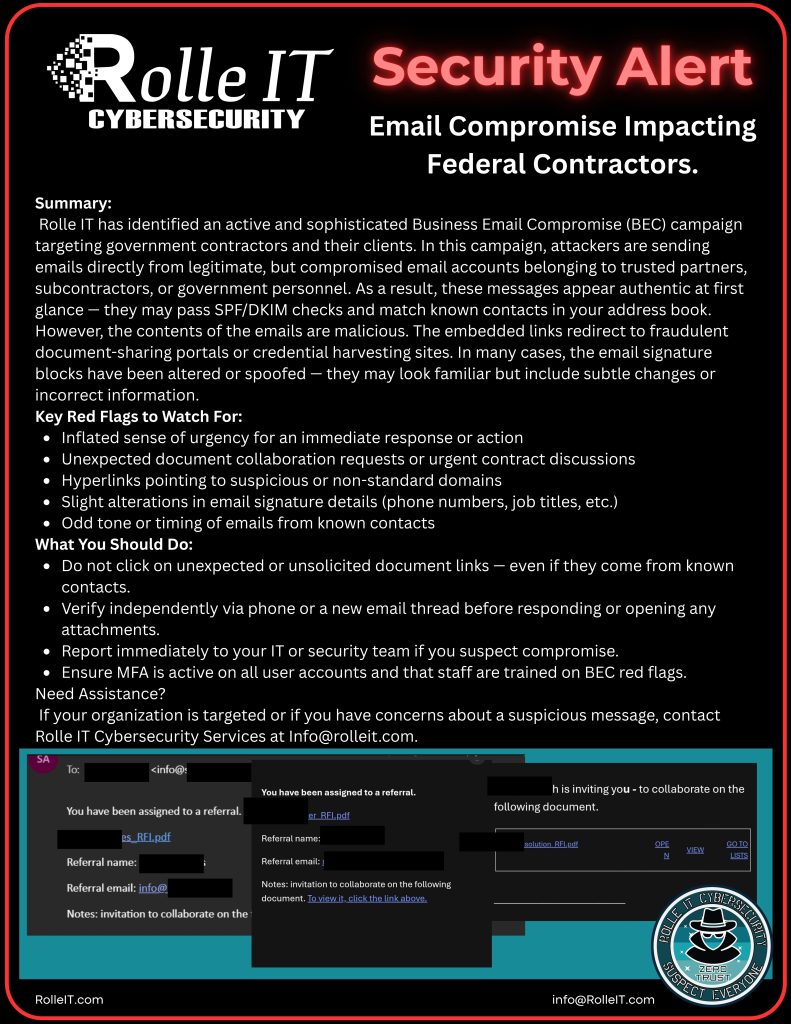
Rolle IT has identified an active and sophisticated Business Email Compromise (BEC) campaign targeting government contractors and their clients. In this campaign, attackers are sending emails directly from legitimate, but compromised email accounts belonging to trusted partners, subcontractors, or government personnel. As a result, these messages appear authentic at first glance — they may pass SPF/DKIM checks and match known contacts in your address book.

However, the contents of the emails are malicious. The embedded links redirect to fraudulent document-sharing portals or credential harvesting sites. In many cases, the email signature blocks have been altered or spoofed — they may look familiar but include subtle changes or incorrect information.

This compromise prompts users to log into their OneDrive, allowing the bad actors access to critical systems and accounts.

Key Red Flags to Watch For:

Inflated Sense of urgency to complete a task
Unexpected document collaboration requests or urgent contract discussions
Hyperlinks pointing to suspicious or non-standard domains
Slight alterations in email signature details (phone numbers, job titles, etc.)
Odd tone or timing of emails from known contacts

What You Should Do:

Do not click on unexpected or unsolicited document links — even if they come from known contacts.
Verify independently via phone or a different communication method before responding or opening any attachments.
Report immediately to your IT or security team if you suspect compromise.
Ensure MFA is active on all user accounts and that staff are trained on BEC red flags.
Ensure you have appropriate Email Security Protection.

Need Assistance?

If your organization is targeted or if you have concerns about a suspicious message, contact Rolle IT Cybersecurity Services at [email protected].
hashtag#BEC hashtag#receipts hashtag#Rolleit hashtag#cybersecurity hashtag#ITRemediation hashtag#cybersecurity hashtag#emailsecurity

business email compromise warning

It’s not actually an invite to collaborate. Read More »

Not all MSSPs are the Same.

Why Choose an MSSP That Understands CMMC?

When it comes to cybersecurity compliance, not all Managed Security Services Providers (MSSPs) are created equal. Choosing an MSSP with expertise in CMMC compliance ensures your organization remains secure while meeting regulatory requirements. Here’s why partnering with a CMMC-focused MSSP Like Rolle IT Cybersecurity is critical:

1. CMMC-Specific Expertise

A CMMC-compliant MSSP understands the unique security and compliance requirements federal contractors must meet, ensuring cybersecurity measures align with specific maturity level controls.

2. Regulatory Compliance Alignment

While a regular MSSP may provide general cybersecurity services, a CMMC-focused MSSP ensures that security policies, practices, and monitoring directly support compliance objectives and audits.

3. Proactive Compliance Support

A CMMC-focused MSSP helps companies prepare for assessments by conducting gap analyses, implementing required controls, and maintaining compliance continuously rather than treating security as a reactive process.

4. Threat Intelligence Tailored to DoD Contractors

A CMMC-focused MSSP understands the specific cyber threats facing the Defense Industrial Base (DIB) and tailors cybersecurity strategies accordingly, providing better protection against nation-state attacks and supply chain risks.

5. Audit and Documentation Readiness

Compliance isn’t just about having security tools in place; it requires proper documentation, logging, and evidence of continuous monitoring. An MSSP with CMMC expertise ensures that companies have the required audit trails and reporting mechanisms.

6. Supply Chain Risk Management

Many federal contractors work within a larger supply chain subject to strict security controls. A CMMC-aware MSSP ensures that security solutions extend to supply chain partners to reduce vulnerabilities.

7. Integration with Government and C3PAOs

MSSPs with CMMC knowledge often collaborate with C3PAOs (CMMC Third-Party Assessment Organizations) and government agencies, making it easier to navigate assessments and maintain compliance.

How Rolle IT Supports Your CMMC Journey

The Rolle IT MSSP team supports many organizations across the Defense Industrial Base and maintains robust CMMC level support. Their expertise guides clients through every stage of cybersecurity maturity — from readiness assessments and remediation to continuous monitoring and audit preparation.

By combining deep technical knowledge, regulatory insight, and an understanding of DIB-specific risks, Rolle IT ensures that your cybersecurity program isn’t just compliant, but resilient and future-ready.

Whether you’re preparing for your first CMMC assessment or looking to enhance your ongoing compliance efforts, Rolle IT’s dedicated MSSP services deliver the security, compliance, and peace of mind your organization needs to thrive in today’s cyber threat landscape.

Ready to strengthen your compliance posture?
Contact Rolle IT today to learn how their CMMC-focused MSSP services can empower your cybersecurity strategy. [email protected]

Not all MSSPs are the Same. Read More »

CMMC Is Here.

CMMC Is Here.

Whether you’ve been preparing for years, or are just thinking about getting started, Rolle IT Cybersecurity is here to help guide your organization on your CMMC Journey.

Cybersecurity Maturity Model Certification Impacts Department of Defense contracts that involve FCI or CUI.

For contracts with FCI, or CUI, the DoD requires contractors’ and subcontractor’s compliance with NIST SP 800-171. Defense contractors will be required to undergo a CMMC self-assessment or a third-party assessment to determine whether that defense contractor has met applicable NIST SP 800-171 requirements.

Rolle IT provides CMMC Consulting, Remediation, Ongoing maintenance, and Administration of CMMC Environments.

Becoming CMMC certified allows companies to: 

• Prove your compliance to retain and secure DoD contracts with FCI and CUI 

• Establish trust for supply chain connections and partnerships 

• Pursue future DoD contract opportunities

Resources from the Department of Defense:

CMMC 101

From the DoD: About CMMC

CMMC Level 2 Assessment Guide

Rolle IT, MSSP Partner to the Defense Industrial Base:

Our Managed Security Services Team provides ongoing security operations to meet many of the required controls

24/7 Threat ManagementCybersecurity TrainingTabletop ExercisesVulnerability Scanning

Rolle IT employs: CMMC Certified Professionals (CCP) – A person who has successfully completed all certification program requirements as outlined by the CAICO for becoming a Level 1 CMMC Assessor. CMMC Registered Practitioners (RP) Professionals who provide CMMC implementation consultative services.

Contact us at [email protected] to learn more about our services and your CMMC Journey.

CMMC Is Here. Read More »

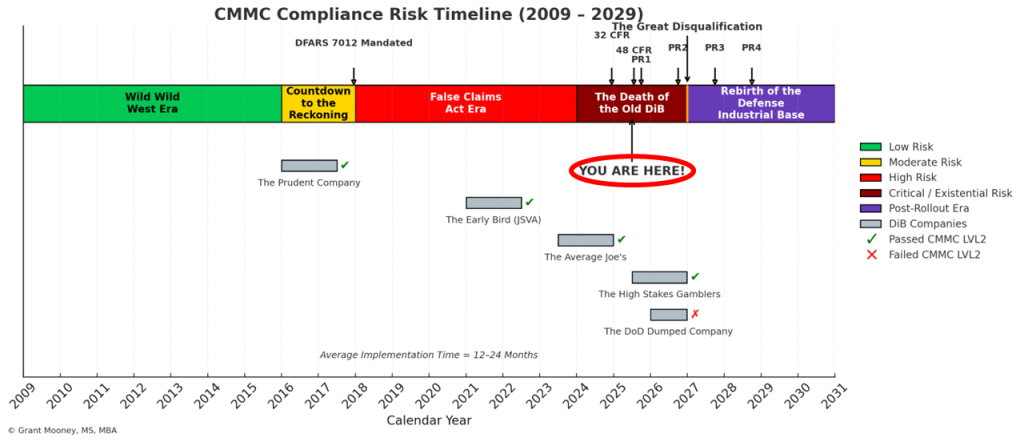
🚨 Why I built this timeline: My goal was simple…to warn and serve the Defense Industrial Base.

By Grant Mooney, CCP

🚨 Why I built this timeline: My goal was simple…to warn and serve the Defense Industrial Base.

I’ve spent the last few weeks working a lot… digging through over 20 years of DoD policy, DFARS clauses, Congress Mandates, NIST standards, and real world NIST 800-171 Lawsuit cases. Too many companies still think CMMC is “just a future contract checkbox.” It’s not.
It’s already a survival issue,

📉 If your business depends on DoD contracts and you haven’t finished implementing NIST 800-171, you’ve already missed the deadline: December 31, 2017!
📍 YOU ARE HERE — in the Death of the Old DiB. The “Great Disqualification” begins soon. Primes are already flowing down Level 2 requirements. If you don’t have a certificate or a plan, you’re already losing opportunities.
🎰 If you’re just now starting to take this seriously in Q2 2025, as a company, you’re a High Stakes Gambler. You’re betting everything on 12–24 months of implementation work in a shrinking window. Many won’t make it.
❌ Others will end up like the DoD Dumped Company on this timeline—disqualified, replaced, or acquired.
✅ But there’s still time to get ahead. I’ve heard the early movers landing more work, closing stronger teaming deals, and becoming go-to suppliers because they got certified while others waited.

This timeline is a warning. It’s also a roadmap. If you’re unsure where your company stands, or how to start, reach out. I’m here to help.

#CMMC

#NIST800171

#DFARS

#CyberCompliance

#DoD

#GovCon

#DIB

#BusinessRisk

hashtag

#FalseClaimsAct

🚨 Why I built this timeline: My goal was simple…to warn and serve the Defense Industrial Base. Read More »

Cyberattack Statistics Affecting Small Businesses

🧨 1. Nearly Half of All Cyberattacks Target Small Businesses

43% of cyberattacks are aimed at small businesses — but only 14% are prepared to defend themselves.
Source: Verizon Data Breach Investigations Report, 2023


💸 2. The Average Cost of a Data Breach for a Small Business is $2.98 Million

For small and mid-sized businesses (SMBs), the average cost of a data breach is nearly $3 million — including downtime, lost business, and recovery.
Source: IBM Cost of a Data Breach Report, 2023


⏳ 3. 60% of Small Businesses Shut Down Within 6 Months of a Cyberattack

A devastating attack doesn’t just hurt your systems — it can end your business. 60% of SMBs go out of business within six months of a cyber incident.
Source: U.S. National Cybersecurity Alliance


🔍 4. Only 26% of Small Businesses Have a Cybersecurity Policy in Place

Most small businesses are underprepared: fewer than 3 in 10 have documented IT security plans or incident response strategies.
Source: Hiscox Cyber Readiness Report, 2023


🧑‍💻 5. Phishing and Ransomware are the Most Common Threats

Over 90% of cyberattacks on small businesses start with phishing emails.
Ransomware attacks on SMBs have increased by 400% since 2020.
Sources: CISA.gov, Sophos State of Ransomware 2023


✅ Takeaway

Small businesses are no longer “too small to target.” A proactive security posture — including regular updates, employee training, endpoint protection, and backup strategies — is essential for resilience.

Cyberattack Statistics Affecting Small Businesses Read More »

Cui-Con 2025- Rolle IT

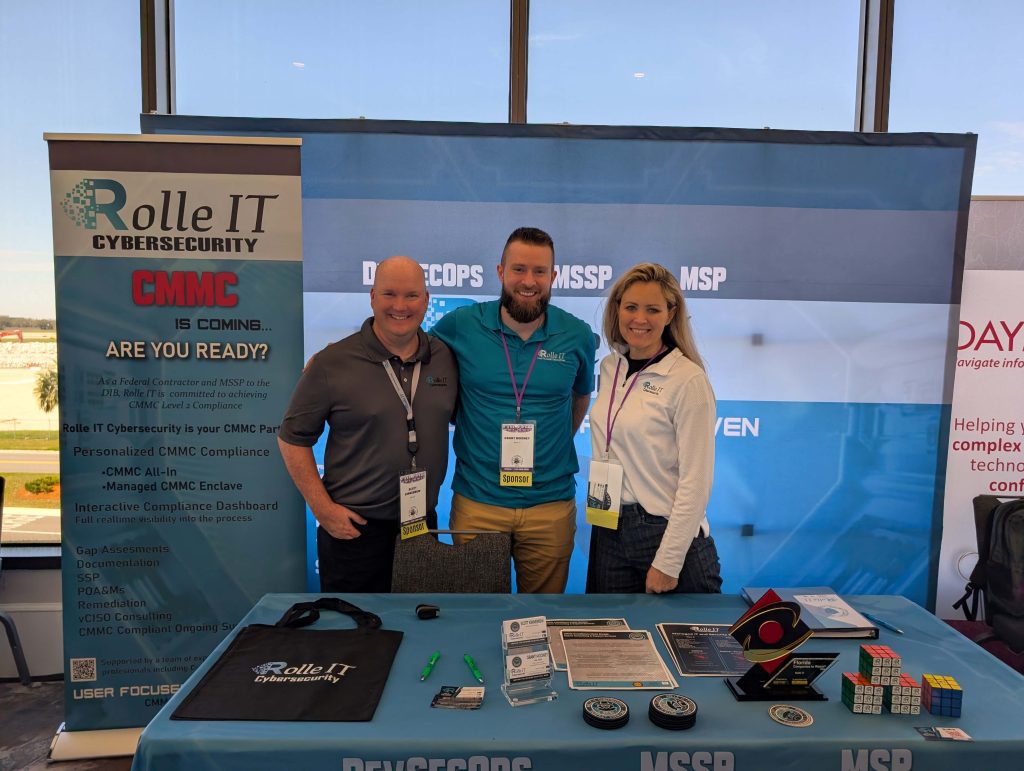
The Rolle IT Cybersecurity Team at Cui-Con 2025: Key Takeaways from the CMMC Ecosystem Event

Rolle IT just wrapped up another great trip to CUI-CON. One of the biggest benefits of attending CUI-CON is the opportunity to interact and hear from the relatively small circle of people who truly understand the CMMC universe and, in many instances, were some of the founding influences in the space. These are the people who have been thinking about what CMMC is and should be for almost a decade, while most of us have only been paying attention to it for a few years. This matters because there is so much fluff and misinformation in the system surrounding CMMC.

We had the chance to discover the latest trends in CMMC implementation and the new, innovative tools available that help all of us manage our certification journeys more efficiently and effectively. This space is still quite young and changing rapidly, so it was great to see many new products and, potentially, forge new relationships that will help our clients succeed.

And speaking of clients, it is always so important and eye-opening to meet new businesses and hear what their challenges and needs are. Of course, we hope to be able to help them in their journey to compliance. But even if they are not new clients, hearing their lessons learned and the challenges that they face help us to understand how to better serve our clients in the future. The reality is that most companies pursuing CMMC alone are significantly underprepared for a Level 2 CMMC assessment and would struggle to achieve a positive SPRS score based on recent conversations.

Rolle IT CUI-Con 2025 CMMC Sponsor

CUICON is an intense, fast-paced environment in which every minute is an opportunity to sharpen your CMMC implementation gameplan. But it is also a fun time to make new friends and reconnect with old ones. But now, it’s back to work with a renewed sense of the importance of the task at hand. But one that feels a little smaller now. CMMC requires allies. Come join us. Contact our Security Team Here

Key Highlights from Cui-Con 2025

1. Expert Panels and Engaging Discussions

The discussions provided actionable insights into the evolving regulatory requirements and how companies can stay ahead of the curve. Our team found tha the presentations were far more targeted than other conferences, addressing key CMMC rollout challenges facing the DIB. Rolle IT’s CCPs found a lot of value in the increased clarity and guidance from industry leaders.

2. Mock Assessment – A Realistic Compliance Experience

One of the most impactful aspects of Cui-Con was the mock assessment sessions, so great to be a part of that robust Q&A. Assessors are not the enemy!

3. Interactive Q&A Sessions

The audience at Cui-Con 2025 came prepared with insightful questions, fostering meaningful discussions with panelists and experts. Attendees were eager to dive into the nuances of compliance challenges, cyber threat mitigation, the role third party providers, and partnerships in maintaining security postures. The openness and willingness of the speakers to engage in constructive and lighthearted discussion was so fun to be a part of.

4. Approachable and Knowledgeable Speakers

The caliber of speakers at Cui-Con 2025 was exceptional. Experts from the Cyber AB, CMMC Third-Party Assessment Organizations (C3PAOs), Third party providers, and cybersecurity firms shared their knowledge and perspectives on the future of compliance. Their accessibility and willingness to provide guidance underscored the collaborative spirit within the CMMC ecosystem.

5. Networking and Collaboration Opportunities

Beyond the sessions, Cui-Con provided numerous opportunities to connect with peers, industry leaders, and potential partners. The conversations we had with other cybersecurity professionals, clients, industry peers, and partners reaffirmed the shared goal of strengthening supply chain security and ensuring that federal contractors are prepared for the challenges ahead.

6. Caution and Due Dilligence

Rolle IT CCP Grant Mooney found that misinformation and mixed messages are still rampant, especially from both product and service providers.

“Every company is trying to sell a product or service, but there’s still not nearly enough focus on actual implementation consulting. As Rolle IT’s Lead CMMC-CCP Consultant, I see companies both overbuying on infrastructure and security tools and others vastly underestimating the complexity of passing a CMMC Level 2 audit. You cannot package CMMC into a box, nor should most companies try to meet all controls internally unless they have the expertise and financial foundation to do so. If you can handle it internally, great—but in my experience, almost every organization benefits from working with a CMMC-aware ESP. Don’t just buy GCC High because a Microsoft rep told you to, and don’t assume pre-written policies alone will get you compliant even if the person selling policies tells you they will. Spending your money the right way in this journey is essential. Take the time to truly understand this massive upcoming shift and determine whether you need consulting or external support.”

Moving Forward with CMMC Readiness

Attending Cui-Con 2025 reinforced the importance of proactive cybersecurity strategies in achieving and maintaining CMMC compliance. The insights gained from this event will enable us to better support our clients as they navigate the complexities of the compliance process. It’s clear from the audience questions, that no two organizations are the same and organizations need to leverage custom solutions to meet CMMC requirements and minimize any impacts on their business operations

At Rolle IT Cybersecurity, we remain committed to staying at the forefront of CMMC developments and helping organizations implement and maintain robust security frameworks. Whether you’re preparing for an upcoming assessment or seeking guidance on maintaining compliance, our team is here to help. Good Luck! Reach out to us if you want our help.

Big Thanks to Fernando Machado and Matthew Titcombe for organizing this event year after year! Looking forward to year #4! Cui-Con 2025, a premier CMMC ecosystem event bringing together industry leaders, organizations seeking assessment, and professionals dedicated to supporting federal contractors in achieving and maintaining CMMC compliance. The event was packed with insightful panels, engaging discussions, and invaluable networking opportunities that deepened our understanding of the evolving CMMC landscape and strengthened our partner relationships

If you missed Cui-Con 2025 or want to learn more about how we can assist in your CMMC journey, contact us today! CMMC @ RolleIT.com 321-872-7576

CUI-CON 2025 Rolle IT Sponsor

Cui-Con 2025- Rolle IT Read More »

Rolle IT Celebrates GrowFL Florida Companies to Watch Honors

Rolle IT Recognized as a 2024 GrowFL Florida Company to Watch

Rolle IT is proud to be named one of the 50 honorees of the 2024 GrowFL Florida Companies to Watch. This recognition highlights the growth, innovation, and leadership of second-stage companies making a significant impact in Florida’s economy.

To celebrate this achievement, our team attended the 14th Annual GrowFL Florida Companies to Watch Awards Gala on February 27, 2025, at the Hard Rock Live in Universal CityWalk, Orlando. The evening was filled with inspiration, networking, and recognition of the businesses that are shaping the future of Florida’s economy.

This award is a testament to the hard work and dedication of our team, as well as the support of our clients and partners. We are honored to be among this year’s winners and look forward to continuing our mission of delivering innovative IT solutions.

Congratulations to all of the 2024 GrowFL Florida Companies to Watch honorees. We are excited for what the future holds and grateful to be part of such a dynamic business community.

Thank you to Jesse McMinn @jesse.william.mcminn for your awesome videography skills

Rolle IT Celebrates GrowFL Florida Companies to Watch Honors Read More »