Cybersecurity Training

Top Cyber Threats Facing Law Enforcement Agencies

(And What CJIS-Compliant Organizations Must Do About Them)

Cyber threats targeting law enforcement agencies continue to increase in both scale and sophistication, driven by ransomware evolution, credential theft, and nation-state activity.

Recent federal cybersecurity advisories confirm that ransomware actors are actively exploiting vulnerabilities across organizations worldwide, including government systems.

For organizations responsible for CJIS compliance in Florida, these threats directly impact:

  • CJIS audit outcomes
  • Operational continuity
  • Access to critical systems like NCIC and FCIC

Why Law Enforcement Remains a High-Value Target

Law enforcement environments include:

  • Always-on systems (CAD, RMS, dispatch)
  • Sensitive criminal justice data (CJI)
  • Federally connected systems (CJIS, NCIC, fusion centers)

Attackers target these systems because disruption and data exposure have immediate operational consequences.

Recent federal enforcement actions highlight that ransomware groups continue targeting critical infrastructure and government systems, posing ongoing risks to public safety.


Top Cyber Threats Facing Law Enforcement Agencies

1. Ransomware Attacks and Extortion

Ransomware remains the most critical threat to CJIS-regulated environments.

  • Modern ransomware includes data theft + encryption (double extortion)
  • Threat actors exploit unpatched systems and weak credentials
  • Attacks target public safety and government infrastructure

Federal advisories show ransomware campaigns impacting organizations across 70+ countries using known vulnerabilities.

Real-world example:
The U.S. Department of Justice coordinated a global disruption of the BlackSuit (Royal) ransomware group, which had targeted critical infrastructure and generated millions in illicit proceeds.

CJIS Impact:

  • System encryption and downtime
  • Data exfiltration
  • Immediate compliance violations

2. Credential Theft and Identity-Based Attacks

Credential-based attacks are now a primary intrusion method.

Attackers use:

  • Phishing and spear phishing
  • Infostealer malware
  • Credential replay and MFA bypass

These techniques allow attackers to operate using valid credentials, making detection more difficult.

CJIS Impact:

  • Unauthorized CJIS access
  • Violations of access control requirements
  • Increased audit risk

3. Malware-as-a-Service and Infostealers

Cybercrime has become highly scalable.

  • Malware platforms enable repeated attacks across many victims
  • Infostealers harvest credentials silently
  • Attack infrastructure is reused across campaigns

Law enforcement operations have disrupted malware ecosystems, but reports show these networks quickly re-form after takedowns.

CJIS Impact:

  • Silent data exfiltration
  • Long dwell times before detection
  • Compromised CJIS-connected endpoints

4. Supply Chain and Vendor Risk

Third-party vendors remain a critical vulnerability.

Law enforcement depends on:

  • CAD/RMS vendors
  • Cloud platforms
  • Managed service providers

Recent enforcement actions demonstrate how ransomware groups target critical infrastructure sectors through interconnected systems.

CJIS Compliance Note:
Agencies are still responsible under the CJIS Security Addendum, even when a vendor is compromised.

CJIS Impact:

  • Vendor breach = agency liability
  • Increased audit scrutiny
  • Potential non-compliance findings

5. AI-Accelerated Cyberattacks

Attackers are increasingly leveraging automation and advanced tooling.

Federal cybersecurity efforts emphasize the need for continuous monitoring and rapid detection as threats evolve.

This shift increases:

  • Attack speed
  • Volume of phishing and malware campaigns
  • Difficulty of detection

CJIS Impact:

  • Faster compromise timelines
  • Greater reliance on real-time monitoring
  • Increased risk of undetected breaches

6. Operational Disruption and System Downtime

Cyberattacks are increasingly focused on availability and disruption.

Targets include:

  • Dispatch systems
  • Records management systems
  • Law enforcement IT infrastructure
  • Email Systems

Ransomware campaigns are specifically designed to halt operations and force rapid response decisions.

CJIS Impact:

  • Violations of availability requirements
  • Public safety consequences
  • Immediate compliance exposure

The CJIS Compliance Connection

Each of these threats directly maps to CJIS Security Policy requirements:

CJIS mandates:

  • Continuous monitoring and logging
  • Incident response capability
  • Strong authentication and access control
  • Vendor risk management

Organizations pursuing CJIS compliance in Florida must implement these controls or risk:

  • CJIS audit failures
  • Loss of CJIS system access
  • Legal and operational consequences

Why a CJIS MSSP is Critical

A CJIS MSSP (Managed Security Services Provider) helps agencies:

  • Monitor systems 24/7
  • Detect and respond to threats quickly
  • Maintain continuous CJIS compliance

This is especially critical for agencies without dedicated internal security teams.


How Rolle IT Cybersecurity Supports CJIS Compliance

Rolle IT Cybersecurity is a trusted CJIS MSSP supporting agencies and contractors across Florida. Contact Rolle IT Cybersecurity for more information [email protected] 321-872-7576

Core Services:

  • 24/7 SOC monitoring and threat detection
  • CJIS-compliant incident response planning
  • Endpoint protection (CrowdStrike-powered)
  • Vulnerability management and hardening
  • CJIS audit help and remediation

Outcomes:

  • Maintain uninterrupted CJIS access
  • Reduce risk of cyber incidents
  • Pass CJIS audits with confidence
  • Strengthen operational resilience

Final Takeaway

The most significant cyber threats facing law enforcement today include:

  • Ransomware and extortion attacks
  • Credential theft and identity compromise
  • Malware and infostealer ecosystems
  • Supply chain vulnerabilities
  • Rapidly evolving attack methods

For organizations handling CJI, cybersecurity is inseparable from compliance.

Agencies that adopt proactive, CJIS-aligned cybersecurity strategies especially with a qualified CJIS MSSP are best positioned to:

  • Protect sensitive data
  • Maintain operations
  • Achieve CJIS compliance in Florida

FAQ

What is CJIS compliance in Florida?

CJIS compliance in Florida means adhering to the FBI CJIS Security Policy as enforced by FDLE, including requirements for access control, encryption, incident response, and auditing.


What are the biggest cybersecurity threats to law enforcement?

The top threats include ransomware, credential theft, phishing, malware infections, and supply chain attacks targeting sensitive law enforcement systems.


What is a CJIS MSSP?

A CJIS MSSP is a managed security provider that delivers monitoring, detection, and incident response services aligned with CJIS requirements.


What happens if you fail a CJIS audit?

Failure can result in corrective actions, increased oversight, or loss of access to CJIS systems such as NCIC or FCIC.


How can agencies prepare for a CJIS audit?

Preparation includes implementing monitoring, incident response plans, access controls, documentation, and working with a CJIS MSSP. Contact Rolle IT Cybersecurity for more information [email protected] 321-872-7576


Why is incident response critical for CJIS compliance?

Incident response ensures agencies can detect, contain, and report breaches involving CJI, which is a core CJIS requirement.


Sources

Top Cyber Threats Facing Law Enforcement Agencies Read More »

Cybersecurity Tabletop Exercises for CJIS and Critical Infrastructure Organizations

How Law Enforcement and Critical Infrastructure Teams Prepare for Cyber Incidents

Cyberattacks targeting law enforcement agencies, public safety systems, and municipal infrastructure have become one of the fastest-growing threats facing government organizations.

Ransomware groups, cybercriminal syndicates, and nation-state actors increasingly target organizations that manage critical systems and sensitive data, including criminal justice information (CJI).

For agencies operating under the CJIS Security Policy, protecting that data is both a legal requirement and a public safety responsibility.

One of the most effective ways to prepare for cyber incidents is through cybersecurity tabletop exercises.

These structured simulations help agencies test their ability to respond to cyberattacks before a real crisis occurs.

At Rolle IT, we work with law enforcement agencies and critical infrastructure teams to conduct realistic tabletop exercises that strengthen incident response readiness and CJIS compliance.

Understanding Cybersecurity Risks for CJIS and Public Safety Systems

Public sector organizations are attractive targets for cybercriminals because their systems often support essential services.

Common targets include:

  • Law enforcement databases
  • Emergency dispatch systems
  • municipal networks
  • utility control systems
  • transportation infrastructure

When cyber incidents disrupt these systems, the consequences can extend beyond IT outages.

They may impact:

  • emergency response operations
  • officer safety
  • public safety communications
  • access to investigative databases
  • continuity of government services

Because of these risks, agencies responsible for protecting criminal justice information must ensure they are prepared to respond quickly and effectively.

What Is a Cybersecurity Tabletop Exercise?

A cybersecurity tabletop exercise is a guided discussion-based simulation that walks participants through a realistic cyber incident scenario.

Rather than testing technology, the exercise evaluates:

  • incident response procedures
  • decision-making processes
  • communication and escalation protocols
  • coordination between departments
  • regulatory reporting requirements

Participants discuss how they would respond to each stage of an evolving cyber incident.

This format allows organizations to identify weaknesses in their response plans without disrupting operations.

Why Tabletop Exercises Are Essential for CJIS-Regulated Organizations

Many agencies have incident response plans on paper but limited experience executing them under pressure.

During a real cyberattack, teams must make rapid decisions involving:

  • system containment
  • forensic evidence preservation
  • CJIS reporting requirements
  • communication with leadership and law enforcement partners
  • public communications and media inquiries

Tabletop exercises expose gaps in these processes before an actual incident occurs.

For organizations responsible for criminal justice information, this preparation is essential.

Rolle IT’s Methodology for Cybersecurity Tabletop Exercises

Rolle IT conducts structured tabletop exercises designed specifically for CJIS environments and critical infrastructure organizations.

Our approach focuses on realism, operational coordination, and regulatory alignment.

Scenario Development Based on Real Threats

Each exercise begins with the development of a customized scenario reflecting current cyber threats affecting government organizations.

Examples include:

  • ransomware spreading across a CJIS network
  • unauthorized access to law enforcement databases
  • supply chain compromise impacting emergency communications systems
  • insider misuse of sensitive criminal justice information

These scenarios are mapped to NIST incident response phases and CJIS security requirements.

Multi-Department Participation

Cyber incidents affect more than IT teams.

Effective tabletop exercises involve leadership from across the organization, including:

  • IT and cybersecurity teams
  • CJIS security officers
  • command staff or agency leadership
  • legal and compliance teams
  • public communications personnel

This approach ensures agencies practice responding to incidents as a coordinated organization.

Progressive Incident Simulation

During the exercise, facilitators introduce new developments that evolve the scenario.

Participants must respond to situations such as:

  • detection of suspicious network activity
  • system outages affecting operations
  • ransomware demands
  • potential exposure of criminal justice information
  • media or regulatory inquiries

This evolving structure helps teams practice responding to the complexity of real cyber incidents.

After-Action Analysis and Security Improvements

Following the exercise, Rolle IT conducts a detailed review of the organization’s response.

This analysis evaluates:

  • communication and coordination
  • CJIS policy adherence
  • incident escalation procedures
  • forensic readiness
  • recovery and continuity planning

Organizations receive actionable recommendations to improve their incident response capabilities and cybersecurity posture.

Aligning with National Cybersecurity Standards

Rolle IT tabletop exercises are aligned with widely recognized cybersecurity frameworks.

These include:

  • CJIS Security Policy
  • NIST SP 800-61 Incident Response Guide
  • NIST SP 800-171
  • CISA critical infrastructure guidance

This alignment ensures exercises help organizations meet both regulatory requirements and operational security goals.

The Growing Cyber Threat to Critical Infrastructure

Cybercriminal groups increasingly target organizations that support essential public services.

Recent incidents have demonstrated how ransomware and cyber espionage campaigns can disrupt:

  • emergency communications
  • municipal government operations
  • law enforcement networks
  • utility infrastructure

For agencies responsible for protecting communities, cyber preparedness has become a critical operational priority.

Building Cyber Resilience Through Realistic Exercises

Tabletop exercises are one of the most effective ways for organizations to strengthen cyber resilience.

Agencies that conduct regular exercises gain:

  • faster incident response coordination
  • clearer leadership decision processes
  • improved CJIS compliance awareness
  • stronger communication across departments
  • greater confidence during real cyber incidents

Preparing for cyber threats before they occur is essential for protecting both public safety systems and sensitive criminal justice information.

Strengthening Cybersecurity for Public Sector Organizations

At Rolle IT, we help law enforcement agencies, government organizations, and critical infrastructure teams prepare for evolving cyber threats.

Our cybersecurity services include:

  • CJIS cybersecurity compliance consulting
  • cybersecurity tabletop exercises
  • managed detection and response (MDR)
  • security operations center (SOC) monitoring
  • incident response planning

Through realistic training and advanced cybersecurity capabilities, we help organizations protect the systems that communities rely on every day.

Rolle IT facilitates Tabletop Exercises with organizations of all sizes. Contact us at [email protected] for more information.

Cybersecurity Tabletop Exercises for CJIS and Critical Infrastructure Organizations Read More »

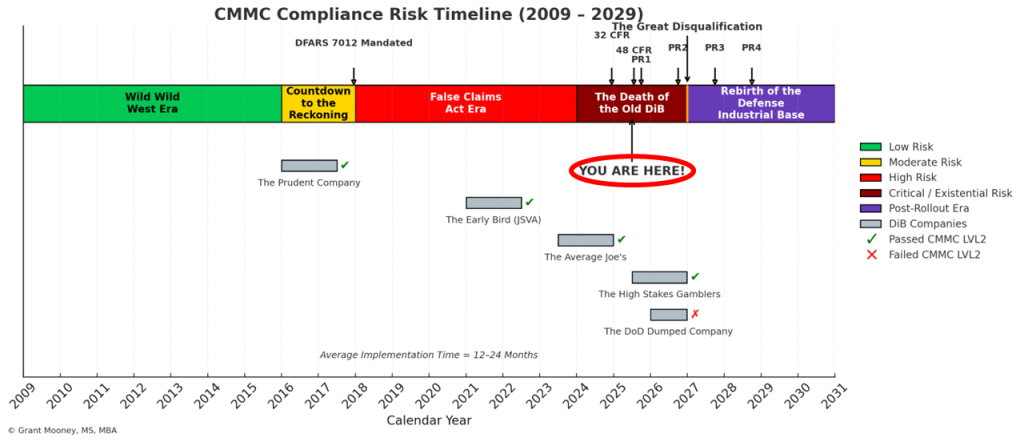
🚨 Why I built this timeline: My goal was simple…to warn and serve the Defense Industrial Base.

By Grant Mooney, CCP

🚨 Why I built this timeline: My goal was simple…to warn and serve the Defense Industrial Base.

I’ve spent the last few weeks working a lot… digging through over 20 years of DoD policy, DFARS clauses, Congress Mandates, NIST standards, and real world NIST 800-171 Lawsuit cases. Too many companies still think CMMC is “just a future contract checkbox.” It’s not.
It’s already a survival issue,

📉 If your business depends on DoD contracts and you haven’t finished implementing NIST 800-171, you’ve already missed the deadline: December 31, 2017!
📍 YOU ARE HERE — in the Death of the Old DiB. The “Great Disqualification” begins soon. Primes are already flowing down Level 2 requirements. If you don’t have a certificate or a plan, you’re already losing opportunities.
🎰 If you’re just now starting to take this seriously in Q2 2025, as a company, you’re a High Stakes Gambler. You’re betting everything on 12–24 months of implementation work in a shrinking window. Many won’t make it.
❌ Others will end up like the DoD Dumped Company on this timeline—disqualified, replaced, or acquired.
✅ But there’s still time to get ahead. I’ve heard the early movers landing more work, closing stronger teaming deals, and becoming go-to suppliers because they got certified while others waited.

This timeline is a warning. It’s also a roadmap. If you’re unsure where your company stands, or how to start, reach out. I’m here to help.

#CMMC

#NIST800171

#DFARS

#CyberCompliance

#DoD

#GovCon

#DIB

#BusinessRisk

hashtag

#FalseClaimsAct

🚨 Why I built this timeline: My goal was simple…to warn and serve the Defense Industrial Base. Read More »

Insider Threats and MSSPs: Protecting Your Organization from Within

Rolle IT provides MSSP Services to the Defense Industrial Base and Beyond.

In today’s rapidly evolving cybersecurity landscape, the focus is often placed on external threats—hackers, phishing attacks, and malicious software. However, one of the most dangerous and insidious risks to an organization is the insider threat. These threats can come from employees, contractors, or business partners who have legitimate access to company systems and data.

Understanding insider threats and how Managed Security Service Providers (MSSPs) like Rolle IT can help defend against them is crucial for safeguarding your organization. This blog explores the nature of insider threats and how partnering with an MSSP can offer a comprehensive approach to protection.

What Are Insider Threats?

Insider threats refer to security risks originating from individuals within an organization who misuse their access to harm the company. These threats can be classified into three categories:

  1. Malicious Insiders: These individuals intentionally seek to cause harm. Their motivations may vary, from financial gain to revenge or even ideological reasons.
  2. Negligent Insiders: This group includes employees who, through lack of training, carelessness, or lack of awareness, inadvertently compromise security. Examples include clicking on phishing emails or mishandling sensitive data.
  3. Compromised Insiders: These are individuals whose accounts or credentials are taken over by external actors. The threat may not be from the insider themselves but from a malicious external entity using the insider’s privileges.

Regardless of the category, insider threats pose a significant risk, often because these individuals have access to sensitive systems and data that external attackers might find difficult to reach.

The Risks of Insider Threats

The dangers posed by insider threats are real and tangible:

  • Data Breaches: Malicious insiders can steal or leak sensitive information such as financial records, trade secrets, and customer data.
  • Intellectual Property Theft: Employees or contractors who leave an organization may take valuable intellectual property with them, potentially enabling competitors to gain a strategic advantage.
  • Operational Disruption: Insiders may intentionally or unintentionally cause operational failures, either through sabotage or through negligence (e.g., misconfiguring critical systems).
  • Financial Loss: The fallout from insider threats can result in costly legal fees, regulatory fines, and damage to reputation, all of which contribute to significant financial losses.

How MSSPs Help Protect Against Insider Threats

Managed Security Service Providers (MSSPs) like Rolle IT Cybersecurity play a critical role in defending organizations against insider threats. They offer a suite of cybersecurity services that can help detect, mitigate, and respond to these threats effectively. Here’s how MSSPs assist in this regard:

1. Continuous Monitoring and Threat Detection

Rolle IT Cybersecurity provides round-the-clock monitoring of your systems and networks. Using sophisticated tools and technologies, such as Security Information and Event Management (SIEM) systems, to detect unusual activity that may indicate an insider threat. This could include:

  • Accessing files or systems outside of normal work hours
  • An employee downloading large volumes of sensitive data
  • Sudden changes in user behavior or system configurations

By catching suspicious activities early, Rolle IT’s MSSP teams can help mitigate the damage before it escalates into a full-blown incident.

2. User Behavior Analytics (UBA)

Rolle IT’s MSSP teams implement User Behavior Analytics (UBA) to monitor and analyze employees’ actions across networks and systems. UBA uses machine learning algorithms to detect deviations from normal user behavior patterns, making it possible to identify both malicious and negligent insider threats. This enables Rolle IT to spot threats that may not trigger traditional security alerts but could indicate a breach in progress.

3. Access Control and Privilege Management

Managing user access and privileges is crucial to reducing the risk of insider threats. MSSPs help implement strong identity and access management (IAM) policies, ensuring that employees and contractors only have access to the data and systems necessary for their role. They also implement least privilege principles, meaning that users are granted the minimum level of access required for them to perform their tasks.

Rolle IT’s MSSP teams also deploy multi-factor authentication (MFA) and other advanced security mechanisms to protect sensitive information from unauthorized access, even if an insider’s credentials are compromised.

4. Incident Response and Forensics

In the unfortunate event of an insider threat incident, Rolle IT is equipped with an expert incident response team that can rapidly investigate and respond to the breach. They conduct thorough forensic analysis to trace the source and nature of the attack, understand how the threat evolved, and implement measures to prevent future incidents.

This swift response is critical to minimizing the damage, securing systems, and maintaining business continuity. By managing the investigation and response, MSSPs help limit the impact on your organization’s reputation and finances.

5. Employee Training and Awareness

Negligent insiders are a significant threat, but they are often the result of a lack of security awareness. Rolle IT’s Cybersecurity experts assist in developing and delivering cybersecurity training programs to help employees recognize potential threats, such as phishing scams, suspicious links, and best practices for handling sensitive information.

Regular training ensures that employees understand the risks and know how to take action to mitigate potential threats. By fostering a culture of security awareness, MSSPs help reduce the likelihood of negligence and improve overall organizational security posture.

6. Compliance and Regulatory Assistance

Many industries are subject to strict data protection regulations, such as GDPR, HIPAA, and PCI DSS. An insider breach can have severe legal and financial repercussions for non-compliance. Rolle IT helps ensure that your organization adheres to these regulations by maintaining audit logs, implementing proper data handling procedures, and providing documentation needed for compliance audits.

Conclusion

While external threats will always be a part of the cybersecurity landscape, insider threats should not be underestimated. Whether caused by malicious intent, negligence, or compromised credentials, these threats can have devastating consequences for an organization’s security, finances, and reputation.

Partnering with an MSSP like Rolle IT Cybersecurity provides a proactive and comprehensive approach to insider threat protection. Through continuous monitoring, user behavior analytics, access control, incident response, training, and regulatory compliance, Rolle IT Cybersecurity offers the expertise and tools necessary to safeguard your organization from the inside out.

By staying vigilant and working with trusted cybersecurity partners, you can reduce the risks posed by insider threats and ensure the ongoing protection of your sensitive data and systems.

Insider Threats and MSSPs: Protecting Your Organization from Within Read More »

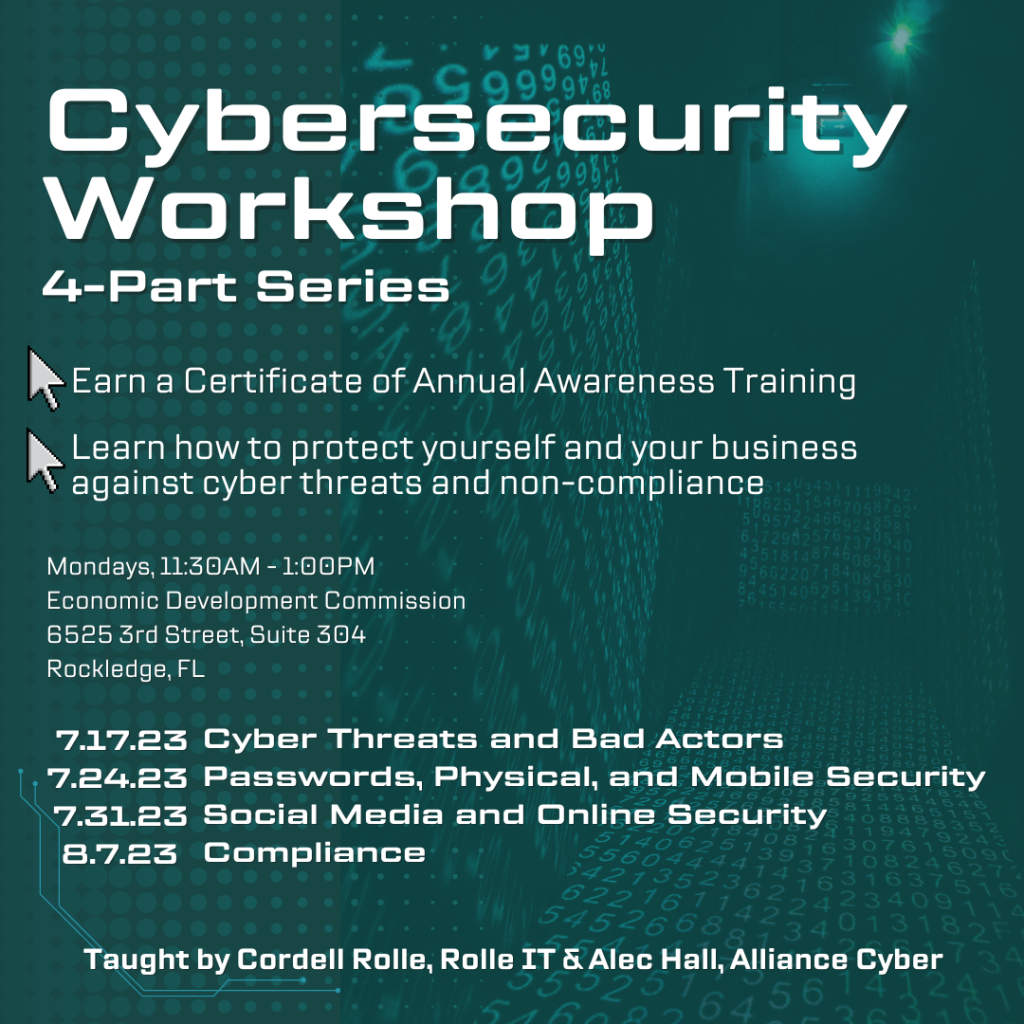
Cybersecurity Workshop July & August 2023

Cybersecurity Workshop- Cocoa Beach Regional Chamber of Commerce (cocoabeachchamber.com)

Cocoa Beach Regional Chamber, Rolle IT and Alliance Cyber Present:

4 Part Cybersecurity Training Series

This is a 4-part series covering the topic of Cybersecurity

  • Earn a Certificate of Annual Awareness Training
  • Learn how to protect yourself and your business against cyber threats.
  • Find out if your business is compliant.

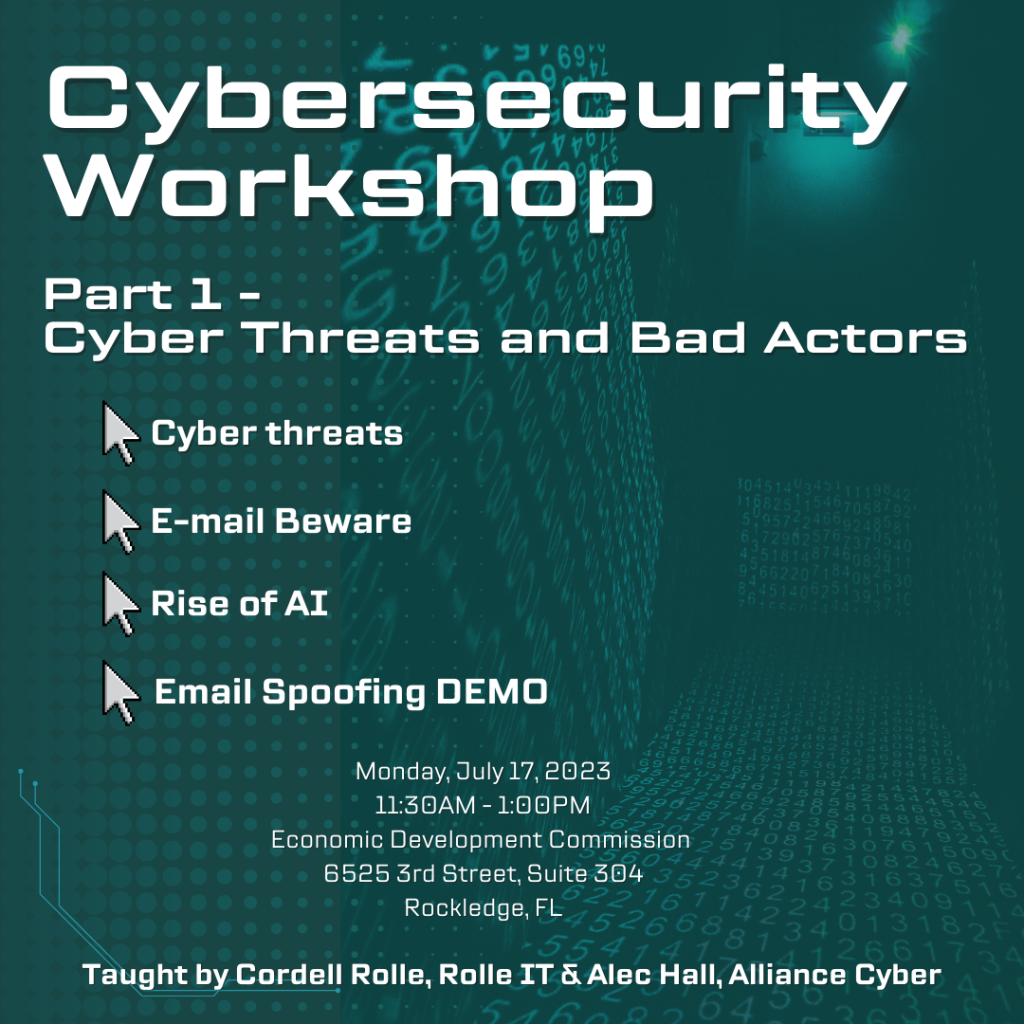
7.17.23 Cyber Threats and Bad Actors Passwords
7.24.23 Passwords, Physical, and Mobile Security
7.31.23 Social Media and Online Security
8.07.23 Compliance

Join us for the entire series or just take single session.

$100 4-Part Workshop

$50 Single Session

Economic Development Commission of Florida’s Space Coast

6525 3rd Street, Suite 304, Rockledge, FL, 32955, United States

 
Instruction led by industry experts Alec Hall with Alliance Cyber and Cordell Rolle with Rolle IT

Cybersecurity Workshop July & August 2023 Read More »